

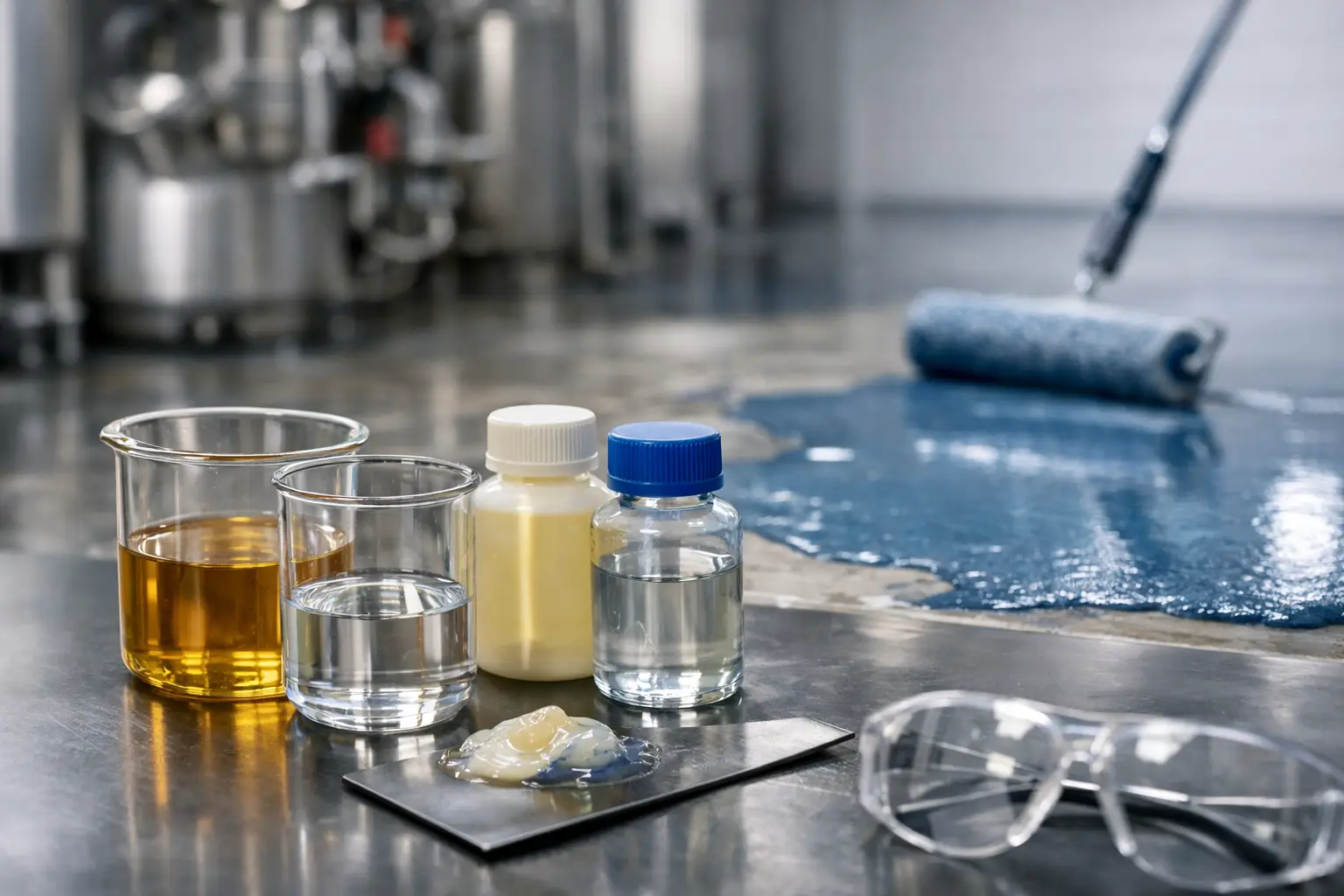
A maintenance-coating batch can have the correct epoxy resin, pigment volume, and solvent balance yet still fail in service because the polyamide curing agent was selected for price rather than formulation fit. The hardener controls much more than cure speed. It affects pot life, application viscosity, film flexibility, adhesion to imperfect substrates, water resistance, and the practical working window available to the production team.
For industrial buyers, polyamide hardener selection is therefore both a formulation decision and a procurement decision. A suitable grade must provide predictable performance with the selected resin system, remain consistent from batch to batch, and be available in the package sizes and shipment schedules needed to keep production moving.
What a Polyamide Curing Agent Does
Polyamide curing agents are amine-functional hardeners commonly used with liquid epoxy resins in protective coatings, marine and maintenance paints, flooring systems, primers, corrosion-control coatings, adhesives, and certain composite applications. They are generally produced from dimerized fatty acids and polyamines, creating a curing-agent family known for flexibility, adhesion, and forgiving room-temperature cure behavior.
When mixed with epoxy resin, active amine hydrogen groups react with epoxy groups to form a crosslinked network. The resulting cured film is usually less brittle than a system cured with many conventional low-molecular-weight amines. That difference matters when a coating must tolerate vibration, thermal movement, impact, or minor substrate deformation without cracking.
In practical terms, polyamides are often chosen when an applicator needs a workable pot life, good wetting and adhesion, and durable performance under atmospheric or moderately corrosive exposure. They are not the automatic best choice for every epoxy system. Higher-temperature service, maximum hardness, rapid low-temperature curing, or highly demanding solvent resistance may point to another hardener family or a modified polyamide system.
Where Polyamide Hardeners Fit Best
The strongest case for a polyamide system is not simply that it cures epoxy. It is that it provides a useful balance of handling and final film properties. For protective coatings, that balance can reduce application risk in field conditions where surface preparation, temperature, humidity, and film thickness are not always perfectly controlled.
Polyamide-cured epoxies typically offer good adhesion to steel, concrete, and previously coated surfaces when surface preparation and formulation design are appropriate. Their flexibility can support use in maintenance coatings and primers where substrate movement or mechanical stress is expected. Water resistance and corrosion protection are also central reasons they are specified in industrial paint systems.
For adhesives, the same flexibility can be valuable where peel resistance and bonded-joint durability matter more than maximum compressive rigidity. In some applications, a formulator may select a polyamide grade to avoid the short pot life and higher brittleness associated with faster-reacting aliphatic amine hardeners.
The trade-off is straightforward. A softer, more flexible cured network may not reach the same hardness, heat resistance, or chemical resistance as an optimized cycloaliphatic amine, phenalkamine, or anhydride-cured epoxy. The right choice depends on the service environment, application method, cure temperature, and property priorities.
Key Specifications to Review Before Purchase
A product name alone is not enough for technical comparison. Procurement and formulation teams should review the data sheet together, beginning with the parameters that affect both mixing and final performance.
Amine Value and Mixing Ratio
Amine value indicates the available amine functionality and provides a useful starting point for comparing curing capacity among grades. The recommended epoxy-to-hardener ratio must be calculated from the epoxy equivalent weight of the resin and the active hydrogen equivalent weight of the curing agent, then confirmed through laboratory evaluation.
Do not assume that two polyamide grades can be exchanged at the same weight ratio. An off-ratio mix can leave unreacted epoxy or excess amine, leading to poor cure, reduced chemical resistance, surface tack, or inconsistent mechanical properties. For commercial production, the supplier’s recommended ratio should be treated as a starting specification, not a replacement for validation with the complete formulation.
Viscosity and Solids Content
Viscosity affects pumping, metering, mixing, spray application, and the amount of solvent required to reach working viscosity. A lower-viscosity polyamide can simplify processing and help reduce solvent demand, but the final decision should account for pigment loading, application equipment, temperature, and desired film build.
Buyers should also confirm whether the product is a 100% solids polyamide or supplied in a solvent solution. Solids content changes the actual active-curing-agent level, volatile organic compound calculations, packaging requirements, and mixing ratio. Comparing a solvent-cut grade directly with a neat grade can produce misleading cost and performance conclusions.
Pot Life, Dry Time, and Cure Profile
Long pot life is one of the practical advantages of many polyamide systems, particularly for large mixed batches or manual application. However, a long pot life may also mean slower early hardness development. A coating that remains workable for several hours may require more time before handling, recoating, or immersion service.
Cure data should be reviewed at the temperatures that reflect actual production or field conditions. Ambient cure at 77°F can differ substantially from performance in a cold shop, on a humid dock, or in an enclosed fabrication area. Confirm tack-free time, through-cure time, recoat window, and any required post-cure conditions before committing a grade to a production schedule.
Color, Blush Resistance, and Appearance
Polyamide hardeners are widely used in pigmented industrial coatings, where color is often less critical than it is in clear coatings or decorative applications. Still, hardener color can influence light-colored systems, and amine-related surface effects can affect intercoat adhesion or appearance under unfavorable humidity conditions.
Where gloss retention, clear-film color, or a highly cosmetic finish is required, test the complete coating system rather than evaluating the hardener in isolation. Pigments, solvents, accelerators, resin grade, application thickness, and curing conditions all influence the final result.
Match the Hardener to the Resin and End Use
Standard liquid epoxy resins such as CYD-127 and CYD-128 are common starting points for polyamide-cured coatings and adhesives. Their relatively low viscosity supports practical mixing and allows formulators to adjust pigment loading, solvent level, and additives without losing application control. Novolac epoxy resins may deliver greater crosslink density and chemical resistance, but they require careful hardener compatibility review and are not a simple substitute in a flexible polyamide formulation.
For a steel maintenance primer, the target may be adhesion, wet-surface tolerance, corrosion protection, and acceptable recoat timing. For an epoxy floor coating, abrasion resistance, film build, cure time, and color stability may carry more weight. For a structural adhesive, the focus may shift toward bond strength, peel resistance, viscosity control, and service temperature. One polyamide curing agent cannot be assumed to optimize all three systems.
Additives should be evaluated as part of the same system. Defoamers, dispersants, rheology modifiers, leveling agents, and fumed silica can improve application and appearance, but they can also change air release, sag resistance, viscosity, and cure response. Accelerators can shorten cure time, yet they may reduce pot life or create a less forgiving application window. Small laboratory adjustments are less expensive than correcting a full production batch.
Practical Qualification for Production Use
A useful qualification program starts with a controlled pilot batch using the intended resin, pigments, solvents, and additives. Record initial viscosity, mix ratio, induction time if applicable, pot life, application behavior, dry-to-touch time, recoating behavior, hardness development, and adhesion. Then test the properties that directly reflect end use, such as water immersion, salt spray, chemical exposure, impact resistance, or bond durability.
It is also worth checking performance at the limits of expected conditions rather than only at laboratory standard conditions. A hardener that performs well at 77°F may behave differently at lower temperatures or under high humidity. Production teams should establish acceptable operating ranges and define what adjustments are permitted without changing the approved formula.
For repeat manufacturing, incoming-material control is equally important. Confirm certificate-of-analysis requirements, lot traceability, packaging integrity, shelf life, storage temperature, and handling procedures. Polyamide curing agents should be protected from contamination and stored according to the supplier’s guidance. Moisture, incorrect storage conditions, and poor drum management can create avoidable viscosity and cure variability.
Supply Planning Matters as Much as Chemistry
A technically suitable hardener becomes a production risk if lead times are uncertain or if a supplier cannot maintain consistent inventory. Industrial buyers should consider annual demand, safety-stock needs, container configuration, export documentation, and the availability of compatible epoxy resin and formulation additives from the same source.
Consolidating epoxy inputs can reduce administrative work and simplify compatibility discussions. Dahua New Materials supplies polyamide and amine curing agents alongside liquid epoxy resins, MTHPA hardener, accelerators, and coating additives, helping buyers align sourcing with formulation requirements instead of managing unrelated supply channels.
Before placing a bulk order, request current technical data, confirm the grade designation and packaging, and agree on the required quality documentation. The most useful supplier relationship is one that can support both the first qualification batch and the repeat orders that follow.
A polyamide curing agent should earn its place in a formulation through verified cure behavior, service performance, and dependable availability. When those three factors align, the hardener becomes a practical tool for protecting production schedules as well as finished surfaces.