

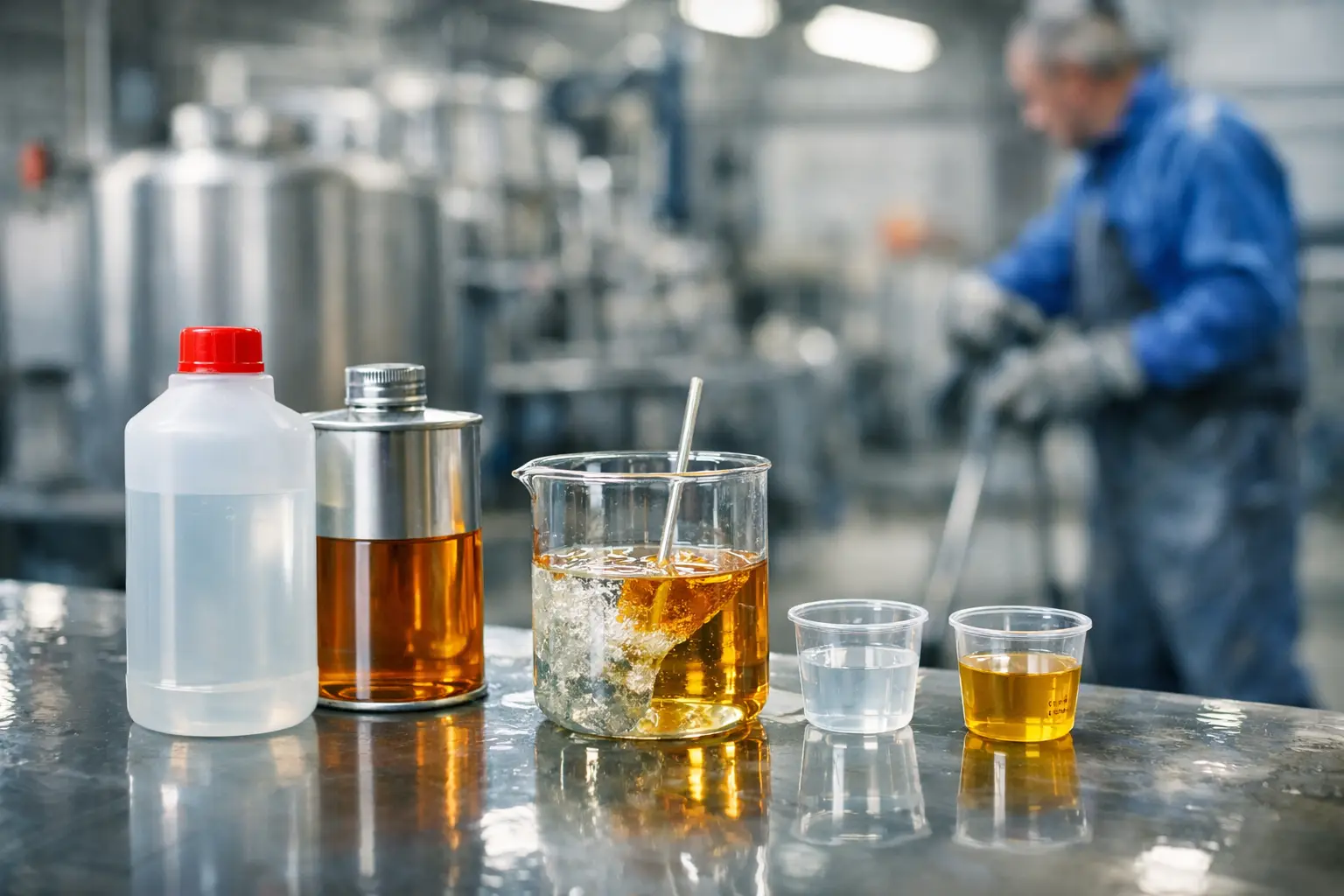
An epoxy resin does not become a durable coating, adhesive, laminate, or encapsulant until the epoxy hardener is correctly matched to the application. The curing agent determines far more than cure speed. It influences viscosity, pot life, crosslink density, thermal performance, chemical resistance, electrical insulation, color stability, and the practical limits of a production line.
For industrial buyers, hardener selection is therefore a formulation and supply decision at the same time. A material that performs well in a lab batch but has inconsistent availability, unsuitable packaging, or an impractical cure schedule can create avoidable production risk. The right choice begins with the end-use requirements, then works backward through resin compatibility, processing conditions, and commercial supply needs.
What an Epoxy Hardener Controls
Epoxy resin contains reactive epoxy groups, but it needs a curing agent to form a crosslinked thermoset network. Different hardener chemistries react in different ways and at different temperatures. This is why one resin grade can produce very different results depending on the hardener, accelerator, filler package, and cure profile used.
The first consideration is the cure condition. Amine hardeners are widely used where ambient or low-temperature curing is required, including many protective coatings, civil construction systems, and structural adhesives. Their reactivity can support fast handling strength, but formulators must manage pot life, exotherm, blush sensitivity, and the final balance between flexibility and chemical resistance.
Polyamide curing agents are often selected when a formulation needs workable pot life, adhesion, flexibility, and corrosion resistance. They are common in coatings and adhesives where practical application properties matter as much as final hardness. Their trade-off is that their cured heat resistance and chemical resistance may not match a more highly crosslinked anhydride or aromatic amine system.
Anhydride hardeners are a different category. They are frequently used in heat-cured epoxy systems for electrical insulation, encapsulation, composites, castings, and laminates. These systems can offer low mixed viscosity, long pot life, low shrinkage, and strong electrical properties. They generally require elevated-temperature curing and, in many cases, an accelerator. That process requirement is worthwhile when the application demands controlled flow before gelation and reliable performance at service temperature.
Selecting an Epoxy Hardener by Application Need
A good starting point is to define which property cannot be compromised. For an electrical encapsulation compound, low viscosity, filler wetting, dielectric performance, and heat resistance may be the primary criteria. For a steel-protection coating, adhesion, corrosion resistance, application window, and cure under site conditions can carry more weight. For a composite part, resin flow, fiber wet-out, glass transition temperature, and the cure cycle often determine success.
Coatings and Structural Adhesives
Ambient-cure amine and polyamide systems are practical choices when parts cannot enter an oven or when field application is required. Fast-reacting amines can shorten turnaround time, but they may reduce the working window for mixing, spraying, rolling, or adhesive placement. Slower systems provide more application latitude, although they may delay handling or full-service readiness.
For structural adhesives, the cure network must be considered alongside the substrate and joint design. A highly rigid system may deliver high strength but become less tolerant of movement, impact, or thermal cycling. A tougher, more flexible hardener can improve durability in a dynamic assembly, even if the initial hardness is lower. The best formulation is not necessarily the one with the highest individual test value. It is the one that retains performance through the actual service conditions.
Electrical Insulation, Encapsulation, and Casting
Electrical applications frequently favor anhydride-cured epoxy systems because they can combine low viscosity with long pot life and excellent electrical insulation. MTHPA, or methyltetrahydrophthalic anhydride, is a widely used anhydride epoxy hardener for these applications. Its low viscosity supports filler loading and flow into complex geometries, while its cured network can provide useful thermal and electrical performance.
Cure schedule discipline is essential. Anhydride systems usually need controlled heat input to develop their intended properties. Under-curing can leave a lower crosslink density and reduce thermal, mechanical, or dielectric performance. Excessive peak exotherm can create stress, voids, discoloration, or uneven cure in thick castings. Production teams should validate both the oven schedule and the actual part temperature, especially after changes in batch size, mold geometry, or filler level.
Composites and Laminates
In composites, resin viscosity and pot life are often decisive. The resin-hardener blend needs enough time to wet reinforcement, release entrapped air, and fill the tool before gelation. At the same time, the system must cure efficiently enough to support the planned molding cycle.
Anhydride systems can be effective for electrical laminates, fiber-reinforced components, and other heat-cured composite applications. The trade-off is equipment capability. If a manufacturer has controlled heating, predictable mold temperatures, and the ability to manage cure cycles, the performance benefits can be compelling. If production depends on room-temperature assembly with variable conditions, a different curing-agent family may be more practical.
Match Hardener Chemistry to the Resin System
Hardener selection cannot be separated from resin selection. Liquid epoxy resins such as CYD-127 and CYD-128 are commonly used starting points for many coatings, adhesives, and electrical formulations, but the final ratio and performance depend on epoxy equivalent weight, hardener equivalent weight, additives, fillers, and the desired cure profile. Novolac epoxy grades, including NPSN 901-75, can support higher functionality and improved heat or chemical resistance in demanding systems, but they may require a curing package designed for their higher reactivity and viscosity profile.
Use stoichiometric equivalents as the technical basis for the initial formulation, rather than relying only on a generic parts-per-hundred-resin ratio. Then confirm the practical ratio through viscosity, gel time, cure response, mechanical testing, and application trials. A small ratio change may affect residual reactivity, brittleness, chemical resistance, and heat distortion behavior.
Accelerators also require careful control. They can reduce cure time or lower the effective cure temperature in anhydride systems, but excessive accelerator can shorten pot life and increase exotherm. The right level depends on the hardener, resin, filler loading, part thickness, and equipment cycle. Formulation teams should evaluate the complete system rather than treating an accelerator as a simple cure-speed adjustment.
Processing Factors That Change Results
Moisture control is especially important for many epoxy curing systems. Water can affect anhydride chemistry, contribute to foaming or voids, and reduce consistency in filled compounds. Keep containers sealed, use dry fillers where required, and avoid introducing moisture through processing equipment or storage conditions.
Viscosity must be evaluated at the actual production temperature. A blend that appears manageable in a warm laboratory may be too viscous in a cooler plant, affecting pumpability, mixing efficiency, air release, and impregnation. Conversely, excessive heating can shorten usable life or accelerate reaction before the material reaches the part. Record viscosity, temperature, and elapsed time together during trials.
Batch-to-batch consistency also depends on mixing. Incomplete dispersion of fillers, pigments, fumed silica, defoamers, or other additives can make a hardener appear inconsistent when the real issue is process control. For filled electrical casting and coating systems, use a defined mixing sequence and adequate vacuum deaeration when the application requires low void content.
Source an Epoxy Hardener for Production, Not Just Testing
A qualified hardener should arrive with clear specifications, stable quality control, suitable packaging, and supply capacity aligned with production demand. Procurement teams should verify more than price. Confirm viscosity range, color, assay or relevant chemical value, moisture limits where applicable, storage requirements, shelf life, lot traceability, and documentation needed for import and plant compliance.
Supply continuity matters most once a product is approved. Reformulating because of an unexpected shortage can cost more than a modest difference in raw-material price. Buyers should assess manufacturer capacity, warehouse inventory, export handling, shipment timing, payment security, and the supplier’s ability to provide related materials in the same purchasing program.
Dahua New Materials manufactures MTHPA epoxy hardener with annual capacity of 45,000 tons and supports industrial buyers with liquid epoxy resins, amine and polyamide curing agents, accelerators, and formulation additives. For manufacturers managing multiple epoxy inputs, this type of consolidated sourcing can simplify purchasing while helping technical teams match materials across the full formulation.
Before approving a new curing agent, run a production-representative trial, not only a small bench test. Use the intended resin, fillers, pigments, additives, mixing method, part geometry, and cure cycle. The data from that trial will show whether the epoxy hardener fits the product and the factory that must make it consistently.