

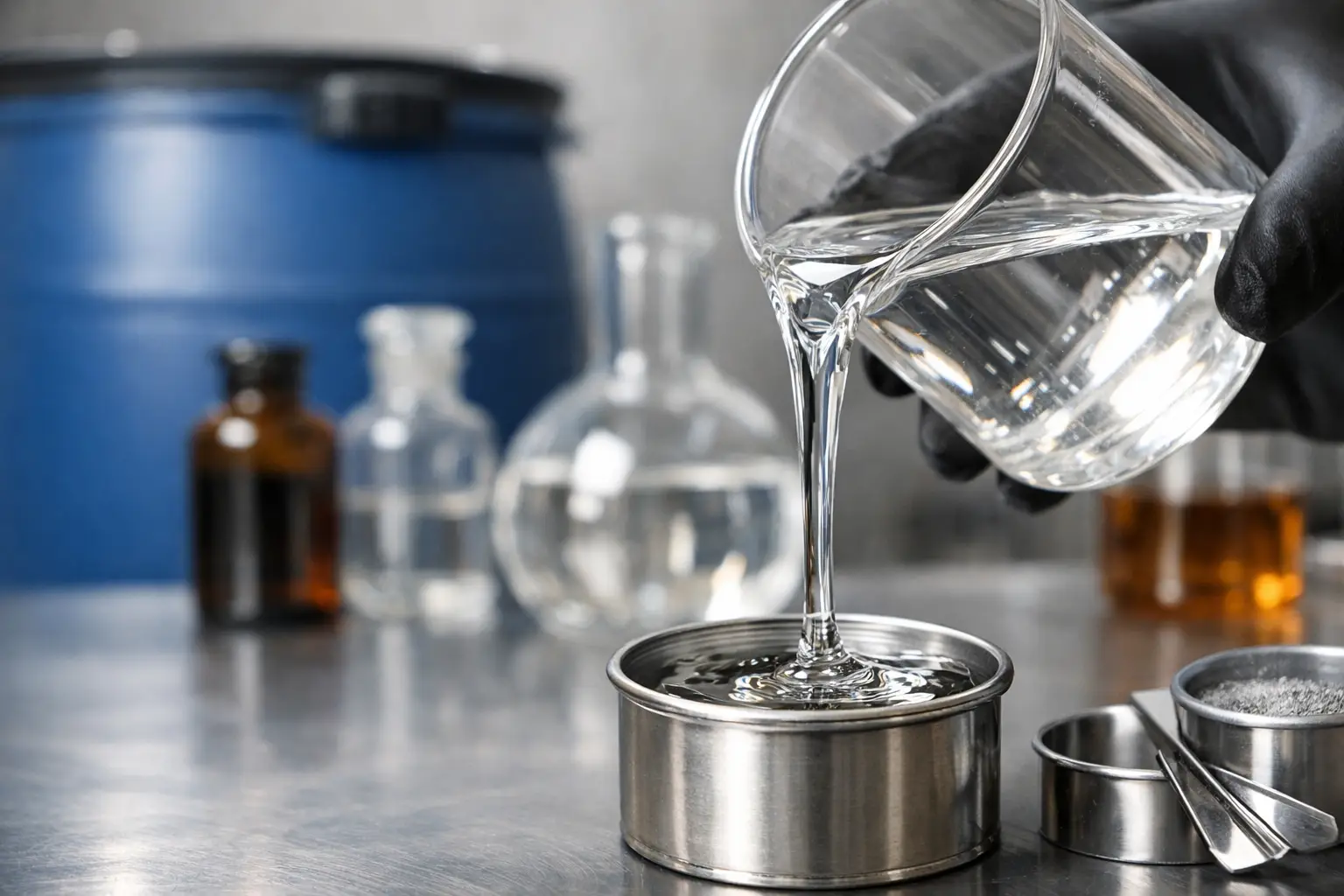
CYD-127 liquid epoxy resin is often selected when a formulation needs the processing convenience of a liquid bisphenol A epoxy resin without giving up the mechanical strength, adhesion, and electrical performance expected from a general-purpose epoxy system. For industrial buyers, the material is not simply a resin line item. Its epoxy equivalent weight, viscosity, color, and consistency from lot to lot affect hardener calculations, plant throughput, and final-product quality.
What CYD-127 Liquid Epoxy Resin Brings to a Formula
CYD-127 is a liquid epoxy resin based on bisphenol A diglycidyl ether chemistry. It is commonly used as a base resin in ambient-cure and heat-cure systems for protective coatings, structural adhesives, electrical insulation materials, composites, laminates, and casting compounds.
Its principal advantage is formulation flexibility. Because it is supplied as a liquid, it can be mixed with compatible curing agents, pigments, fillers, reactive diluents, accelerators, and functional additives without the melting step required by solid epoxy resins. This helps manufacturers simplify batching and maintain more consistent dispersion in production-scale equipment.
The cured performance depends on the complete system, not the resin alone. With a properly selected curing agent, CYD-127 can provide high adhesion to metal, concrete, wood, glass fiber, and many prepared composite substrates. It also supports good chemical resistance, dielectric properties, dimensional stability, and mechanical strength. The actual balance of these properties will vary with the hardener type, cure schedule, filler loading, and service environment.
Typical Properties That Need Procurement Attention
A standard CYD-127 grade is generally evaluated through epoxy equivalent weight, viscosity, hydrolyzable chlorine, color, and volatile content. Typical epoxy equivalent weight values are often in the range used for general-purpose liquid bisphenol A epoxies, while viscosity is commonly measured at 25°C. Buyers should verify the applicable certificate of analysis and technical data sheet for each purchase rather than relying only on a grade name.
Why epoxy equivalent weight matters
Epoxy equivalent weight, often shortened to EEW, is the basis for curing-agent stoichiometry. A change in EEW changes the amount of amine, anhydride, or other curing agent required for a complete cure. If a production formula assumes a fixed EEW but incoming resin varies outside the approved range, the result can be reduced crosslink density, incomplete curing, lower chemical resistance, or avoidable brittleness.
For procurement teams, this means the right specification is not only “CYD-127.” The purchase requirement should define the approved EEW range, testing method, and batch documentation. Formulators should also identify whether the system tolerates adjustment to hardener dosage or requires a tightly controlled resin specification.
Why viscosity affects more than mixing
Viscosity influences pumping, metering, wet-out, pigment dispersion, air release, and coating-film control. A resin that is too viscous can slow production and make high-filler formulations difficult to process. A resin that is too low in viscosity may alter sag resistance, filler suspension, and film-build behavior.
CYD-127 is naturally liquid, but it is not a substitute for a reactive diluent in every formula. When lower application viscosity is needed, formulators should decide whether to use controlled heating, a compatible reactive diluent, solvent reduction, or a different resin grade. Each route has trade-offs. Reactive diluents may change chemical resistance and shrinkage, while solvents introduce drying, emissions, and film-thickness considerations.
Color and purity in finished applications
Color is especially relevant in clear coatings, light-colored flooring systems, electrical potting, decorative castings, and white-pigmented formulas. Low color helps maintain visual consistency, but it should be considered alongside purity and storage history. Exposure to excessive heat, moisture, or contamination can affect resin appearance and downstream performance.
Selecting a Curing System for CYD-127
CYD-127 liquid epoxy resin must be matched to the required cure temperature, working time, end-use environment, and target performance. The same resin can support very different products when paired with different curing chemistries.
Aliphatic and cycloaliphatic amines are common choices for ambient-temperature coatings, adhesives, and repair compounds where fast or moderate cure is needed. They can deliver strong adhesion and practical handling at job-site or factory conditions, although pot life, blush resistance, and moisture sensitivity must be considered carefully.
Polyamide curing agents are frequently used where flexibility, adhesion, and corrosion resistance are priorities, particularly in protective coatings. They may offer a more forgiving application profile than some fast amine systems, but the desired chemical resistance and hardness may require a longer cure or a different curing-agent approach.
For electrical insulation, encapsulation, composites, and heat-cured industrial components, anhydride systems are often an effective fit. MTHPA-based curing systems can provide long pot life, low viscosity, good electrical insulation, and strong thermal performance when cured under the appropriate elevated-temperature schedule. Accelerators can be used to tailor reactivity, but excessive accelerator loading can shorten working time and affect the processing window.
The hardener decision should begin with the production process, not the theoretical final property alone. A high-performance cured network has limited value if the system gels before vacuum degassing, cannot fully wet reinforcement, or creates excessive exotherm in a large casting.
Where the Resin Performs Well
In protective coatings, CYD-127 provides a dependable starting point for primers, floor coatings, marine systems, tank linings, and industrial maintenance coatings. Formulators can adjust viscosity and application behavior with pigments, fillers, flow additives, defoamers, and suitable curing agents. Surface preparation remains essential because epoxy adhesion cannot compensate for oil, loose rust, moisture, or poorly prepared substrates.
In adhesives, the resin can be used in structural bonding formulas for metals, composites, stone, and engineered materials. Tougheners, flexible curing agents, or specialty fillers may be needed where peel strength, impact resistance, or thermal cycling matters more than high rigidity.
For electrical applications, the resin is used in casting, potting, impregnation, and insulation systems. Here, low moisture, controlled viscosity, low air entrapment, and reliable cure conditions are critical. Voids and incomplete cure can reduce dielectric reliability even when the base resin meets specification.
Composite manufacturers use liquid epoxy resin for glass fiber wet-out, hand lay-up, filament winding, and certain molding operations. The required viscosity depends on fiber architecture, filler loading, temperature, and equipment. A system optimized for hand lay-up may not be appropriate for rapid automated processing or thick-section composite parts.
Storage, Handling, and Batch Control
Industrial users should store CYD-127 in tightly closed containers in a dry, temperature-controlled area away from direct sunlight and incompatible materials. Cold storage can increase viscosity and may lead to crystallization in some liquid epoxy resins. If crystallization occurs, use controlled warming and thorough mixing according to the supplier’s handling guidance. Avoid uncontrolled high-temperature heating, which can affect material quality.
Before full-scale production, check the incoming batch against approved parameters and run a small verification mix with the intended curing agent. Practical checks should include mix ratio, initial viscosity, pot life, gel time, cure profile, appearance, hardness, and adhesion or electrical testing as relevant to the application. This is a modest quality-control step that can prevent a costly production interruption.
Supply continuity also deserves the same attention as technical qualification. Resin, hardener, filler, and additives must arrive on a schedule that supports the production plan. Dahua New Materials supports industrial buyers with stocked epoxy raw materials, direct sourcing capability, and matched supply options across liquid resins, MTHPA hardeners, curing agents, and formulation additives.
A productive CYD-127 program starts with a clear specification and a realistic processing trial. When resin properties, curing chemistry, and delivery requirements are aligned before scale-up, the material becomes a reliable foundation for repeatable epoxy manufacturing.