

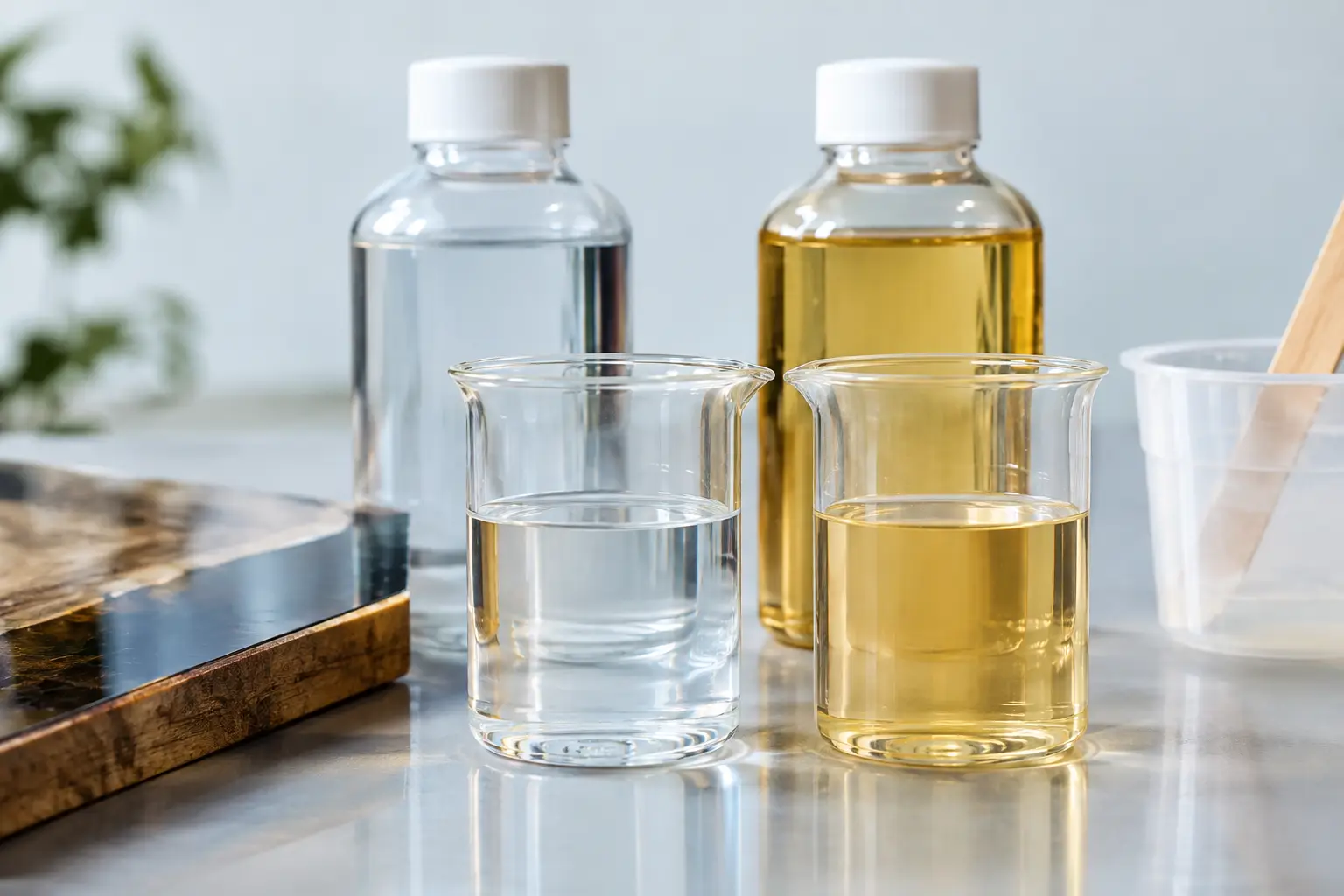
A viscosity reduction can solve a mixing or application problem while creating a cured-performance problem later. That is why reactive diluent versus solvent is not a simple cost comparison for epoxy formulators. One becomes part of the cured network; the other is intended to leave the system. The choice affects resin handling, mix ratio, pot life, VOC compliance, cure schedule, and the mechanical and electrical properties your customer receives.
For coatings, adhesives, electrical encapsulation, and composite processing, the right approach depends on the required application viscosity and the properties that cannot be compromised after cure. A material that gives excellent flow at the pump may be unacceptable if it lowers glass transition temperature, creates porosity, or changes the stoichiometry of the epoxy-hardener system.
Reactive Diluent Versus Solvent: The Fundamental Difference
A reactive diluent is a low-viscosity chemical containing functional groups, commonly epoxy groups, that react during cure. It reduces the viscosity of a liquid epoxy resin and remains in the finished polymer network. Typical epoxy reactive diluents include mono- and multifunctional glycidyl ethers. Their molecular structure, epoxy equivalent weight, functionality, and purity determine how they influence the final formulation.
A solvent reduces viscosity by physical dilution rather than chemical reaction. Depending on the chemistry and application process, it evaporates during flash-off, drying, or thermal cure. Common examples in industrial coatings include ketones, esters, aromatic hydrocarbons, and alcohols. A solvent may be necessary where spray application, rapid wetting, or film formation requires temporary viscosity control.
This difference changes the formulator’s question. With a solvent, the key concerns are evaporation rate, solvency, flash point, retained-solvent risk, and VOC exposure. With a reactive diluent, the key concerns are compatibility, epoxy functionality, curing-agent demand, crosslink density, and end-use performance.
When a Reactive Diluent Is the Better Choice
Reactive diluents are generally selected when low viscosity is needed without introducing volatile material into the process. They are widely used in solvent-free and high-solids epoxy systems, including casting compounds, electrical insulation, flooring, adhesives, and composite impregnation.
Lowering resin viscosity can improve filler loading, fiber wet-out, mixing efficiency, and bubble release. In electrical encapsulation, better flow can help the compound fill narrow spaces around components before gelation. In a heavily filled coating or flooring system, it can improve dispersion and application without relying on a volatile carrier.
The benefit comes with a formulation change, not just a processing adjustment. A monofunctional reactive diluent may reduce viscosity very effectively, but it can also reduce network density because it acts as a chain terminator. Depending on loading and structure, this can lower heat resistance, hardness, chemical resistance, and glass transition temperature. It may improve flexibility or reduce brittleness, which is useful in some adhesive and coating applications, but it should not be assumed to be neutral.
Multifunctional reactive diluents can provide a different balance. They may contribute more effectively to crosslinking and preserve or improve certain cured properties. However, they can also increase reactivity, alter shrinkage, shorten workable time, or make the cured system less flexible. There is no universal “best” reactive diluent. The correct grade is tied to resin type, curing agent, filler package, cure profile, and target specification.
For an anhydride-cured epoxy system using MTHPA, reactive diluent selection requires particular attention to epoxy equivalent calculations. Adding an epoxy-functional diluent changes the total epoxy equivalent weight of the resin blend. The anhydride dosage and accelerator level may need adjustment to maintain the intended cure balance and electrical or thermal performance. Treating the diluent as a simple volume replacement can lead to incomplete cure or an unnecessarily brittle network.
When Solvent Still Has a Practical Role
Solvents remain useful where the application method depends on them. Spray coatings often need a narrow viscosity range for atomization, transfer efficiency, and film appearance. Solvent can also assist substrate wetting, resin dissolution, and leveling in systems where a reactive diluent would remain in the film and change the designed properties.
For certain thin-film coatings, the objective is not to retain a low-molecular-weight modifier in the cured coating. The objective is to apply a uniform wet film, allow controlled evaporation, and leave behind the specified resin-hardener network. In this case, a properly selected solvent blend can provide a better result than a reactive diluent.
The trade-off is process control. Solvent evaporation must be matched to film thickness, temperature, airflow, and cure conditions. If evaporation is too fast, the coating can show poor flow, dry spray, pinholes, or surface defects. If it is too slow, solvent can remain trapped in the film, causing bubbles, reduced adhesion, blushing, odor, or lower chemical resistance after cure.
Solvent use also carries procurement and operational implications. Storage classification, flammability controls, worker exposure, emissions permits, packaging, and transportation requirements can materially affect total production cost. The lowest-priced thinner is not necessarily the lowest-cost option once VOC management and scrap risk are considered.
How the Choice Changes Key Epoxy Properties
Viscosity is the obvious starting point, but it should not be the final decision criterion. Reactive diluents and solvents can produce similar measured viscosity at room temperature while leading to very different results after cure.
Cure behavior and pot life
A reactive diluent can affect cure kinetics through its functionality and concentration. Some grades participate readily in the cure reaction, while others may dilute reactive groups or alter compatibility with the hardener. Pot life can increase or decrease depending on the total formulation.
A solvent often lowers the concentration of reactive components and can make a mixed system appear less reactive. Yet evaporation during heating may concentrate the resin and hardener again. This means gel time measured in an open cup may not predict behavior in a thick film, enclosed mold, or heated production line.
Mechanical and thermal performance
Reactive diluents can improve flexibility, impact resistance, or wetting when selected at controlled levels. They can also reduce tensile strength, modulus, heat distortion resistance, and Tg if they lower crosslink density. Testing the cured system is essential, especially for structural adhesives, high-temperature laminates, and electrical parts.
Solvent should not remain in the final network, but residual solvent can act as a temporary or permanent plasticizer. Incomplete removal may reduce hardness and chemical resistance, while voids created during evaporation can weaken the coating or cast part.
Electrical and chemical resistance
For electrical insulation and electronics encapsulation, low ionic contamination, low moisture uptake, controlled dielectric properties, and complete cure are central requirements. A reactive diluent that increases moisture absorption or changes network polarity may not fit the application even if it improves flow. Residual solvent is equally problematic where void-free encapsulation and stable insulation are required.
Chemical-resistant linings and industrial floor coatings demand a similar discipline. A lower-viscosity formulation may apply more easily, but chemical immersion resistance depends on the cured crosslinked structure, not on the viscosity recorded before application.
A Practical Selection Process for Formulators and Buyers
Start by defining whether viscosity reduction is temporary or permanent. If the final system must remain solvent-free, meet low-VOC targets, or penetrate a filled or reinforced structure, a reactive diluent is often the more appropriate route. If the application requires spray atomization or a controlled evaporation window, solvent may be necessary.
Next, test the full formulation rather than evaluating a diluent in the base resin alone. Measure viscosity across the actual production temperature range, then verify pot life, gel time, cure conversion, hardness, adhesion, Tg, flexibility, and chemical or electrical performance relevant to the end use. For filled systems, also evaluate sedimentation, pigment dispersion, defoaming, and flow after storage.
Purchasing specifications should identify more than a product name. Confirm viscosity, epoxy equivalent weight for reactive grades, color, moisture, hydrolyzable chloride where relevant, purity, and packaging. For solvent grades, confirm water content, evaporation range, flash point, and consistency between shipments. These controls reduce the risk of production adjustments when material arrives from a new lot or supplier.
Dahua New Materials supports industrial buyers with epoxy resins, MTHPA hardeners, curing agents, and formulation additives that can be matched to the viscosity and cure requirements of a complete system. For bulk users, consolidating compatible materials can simplify incoming inspection, inventory planning, and formulation control.
The useful decision is not whether reactive diluent or solvent is universally superior. It is whether the viscosity reduction must disappear after application or must become a controlled part of the cured epoxy network. Make that decision from the final performance specification backward, then validate it under real production conditions before scaling the formulation.