

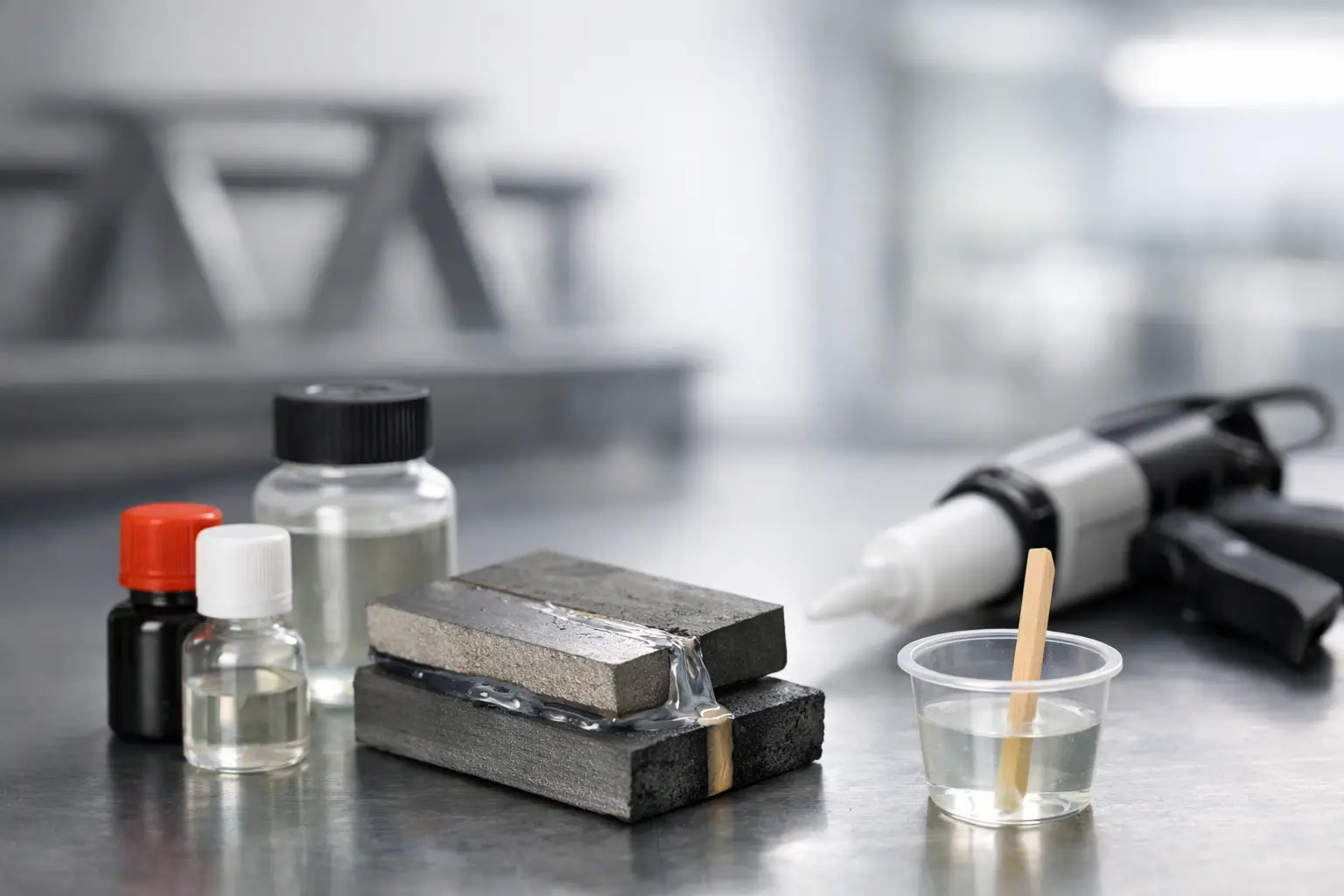
A structural adhesive is only as reliable as its cured network. The resin may establish base strength and chemical resistance, but the curing agent for structural adhesives determines how that network forms: its crosslink density, flexibility, heat performance, working time, and resistance to stress over years of service. For manufacturers bonding metal, composites, concrete, plastics, or electrical assemblies, hardener selection is a production decision as much as a chemistry decision.
The right choice starts with the loading condition and process window, not with a single headline property. A fast-reacting system may improve line throughput but create unacceptable exotherm or too little open time. A highly crosslinked system can deliver strong heat resistance while becoming too brittle for peel, vibration, or thermal cycling. The practical objective is to match cure chemistry to the adhesive’s substrate, joint design, application method, and end-use environment.
What a Curing Agent Does in Structural Adhesives
In a two-component epoxy adhesive, the curing agent reacts with epoxy groups to convert a liquid or paste formulation into a thermoset polymer. Its molecular structure influences the rate of reaction, the final glass transition temperature, adhesion retention, moisture resistance, and mechanical behavior of the bond line.
Structural adhesive formulations often require more than high lap shear strength. They need a controlled viscosity for dispensing, sufficient pot life for mixing and assembly, and predictable cure behavior across seasonal plant temperatures. Once cured, they may need to tolerate impact, peel forces, vibration, solvents, humidity, or repeated movement between hot and cold conditions.
For this reason, formulators commonly balance the curing agent with epoxy type, reactive diluents, toughening modifiers, fillers, accelerators, and adhesion promoters. Changing one component can shift several performance values at once. A hardener cannot be selected in isolation from the full formulation.
Main Types of Curing Agent for Structural Adhesives
Amine curing agents
Aliphatic and cycloaliphatic amines are widely used where room-temperature or moderate-temperature cure is required. They can provide fast cure development, good adhesion, and practical processing for construction adhesives, repair compounds, industrial assembly, and many composite applications.
Their trade-off is that fast reactivity can shorten pot life, especially in high-volume mixes or warm manufacturing conditions. Some amine systems can also develop surface blush in humid conditions, affecting intercoat adhesion or appearance. Modified amines, adducts, and blends are often used to make handling and cure behavior more manageable.
Cycloaliphatic amines are typically considered when improved chemical resistance, color stability, and thermal performance are needed. They may require a higher cure temperature or longer cure schedule than highly reactive aliphatic alternatives, but can offer a useful balance for demanding industrial adhesives.
Polyamide curing agents
Polyamide curing agents are valued for flexibility, adhesion, and tolerance of less-than-perfect substrates. They are often suitable for adhesives that require better peel resistance and impact tolerance than a rigid, highly crosslinked amine system can provide.
For metal bonding, maintenance, marine, and general industrial applications, polyamides can support a forgiving formulation profile. They generally deliver lower heat resistance and lower glass transition temperature than anhydride-cured systems, so they are not the automatic choice for high-temperature structural assemblies. However, where bond durability and application practicality matter more than maximum thermal performance, they remain highly useful.
Anhydride curing agents
Anhydride systems, including MTHPA-based hardeners, are primarily used when high thermal stability, electrical insulation, low viscosity, and long pot life are priorities. They are especially relevant in electrical encapsulation, laminates, composites, and structural adhesive applications that can use elevated-temperature curing.
MTHPA has low viscosity and supports high filler loading, which can help formulators control flow, reduce shrinkage, and improve thermal management. Its long pot life can be an advantage for large bonded assemblies, automated dispensing operations, and formulations requiring careful degassing. The trade-off is cure temperature: anhydrides normally need heat and are often paired with an accelerator to achieve an efficient production schedule.
For manufacturers using heated presses, ovens, or controlled thermal cure stations, an anhydride-curing agent for structural adhesives can provide a strong route to higher heat resistance and stable electrical properties. The exact cure profile must be verified through laboratory and production trials because accelerator level, resin functionality, filler loading, and bond-line thickness all affect gel time and final performance.
Hybrid and modified systems
Many commercial structural adhesives use modified or hybrid hardener packages rather than a single standard curing chemistry. An amine may be combined with toughening technology to improve impact resistance. An anhydride system may use an accelerator package to tune cure speed. Polyamide blends may be selected to improve flexibility while preserving acceptable chemical resistance.
This approach gives formulators more control, but it increases the need for batch consistency and technical coordination. A minor shift in amine value, viscosity, moisture content, or accelerator concentration can influence application time and cure response on the production floor.
Match Cure Chemistry to the Service Requirement
Start with the failure mode the adhesive must prevent. If the joint will see peel and vibration, toughness and elongation may matter more than the highest possible tensile shear value. If it will operate near electrical components or elevated temperatures, thermal stability, dielectric properties, and low ionic contamination may take priority. For outdoor construction use, resistance to humidity, thermal cycling, and substrate movement must be considered together.
The substrate also changes the selection. Steel, aluminum, glass, carbon fiber composite, and engineering plastics each present different surface energies, oxide layers, coefficients of thermal expansion, and contamination risks. A curing agent that performs well on prepared metal may not provide the same adhesion durability on a low-energy plastic without surface treatment or an adhesion promoter.
Cure conditions are equally important. Room-temperature assembly favors reactive amine or polyamide systems. Heat-cure production can use anhydrides and other latent or slower-reacting chemistries that provide longer processing time before building a high-performance network. Do not specify a cure agent based only on a datasheet cure time. Verify actual gel time and fixture time at the plant’s expected mix volume and ambient temperature.
Key Formulation and Production Checks
A reliable qualification program should measure more than initial bond strength. Test viscosity over the expected storage period, pot life after mixing, exotherm in realistic package or bead sizes, and cure completion at minimum and maximum plant temperatures. Then evaluate lap shear, peel, impact, and aging after the environmental exposures relevant to the application.
Four production factors deserve particular attention:
- Stoichiometry: The epoxy equivalent weight and hardener equivalent weight must be accurately matched. Off-ratio mixing can leave unreacted groups, reduce heat resistance, or create a brittle bond.
- Moisture control: Moisture can interfere with certain curing systems, affect appearance, and create voids or inconsistent properties. Dry storage and controlled handling are especially important for moisture-sensitive raw materials.
- Exotherm management: Larger mixed volumes and thicker bond lines retain heat. A formulation that cures safely in a laboratory cup may react too rapidly in a production cartridge, pail, or bonded assembly.
- Filler compatibility: Fumed silica, mineral fillers, pigments, and tougheners change flow, heat transfer, and reaction behavior. Confirm dispersion quality and recheck cure performance after each significant formulation adjustment.
For high-volume supply, raw material continuity is also part of qualification. Buyers should confirm manufacturing capacity, batch traceability, warehouse availability, packaging options, and shipment timing before moving an adhesive into regular production. A technically suitable hardener is not enough if lead times create line interruptions or material changes force repeated validation.
Sourcing for Consistent Adhesive Production
A direct manufacturer and broad raw-material supplier can simplify structural adhesive procurement. Dahua New Materials manufactures MTHPA epoxy hardener with 45,000 tons of annual capacity and also supplies liquid epoxy resins, amine and polyamide curing agents, accelerators, and formulation additives. This allows formulators and purchasing teams to coordinate compatible inputs rather than sourcing each part of an epoxy package through unrelated channels.
For repeat industrial orders, ask for the specifications that influence your process: viscosity range, color, acid value or amine value where applicable, moisture control, recommended mixing ratio, storage conditions, and available technical documentation. Request a production-representative sample, not only a small laboratory sample, when the adhesive will be used in a critical assembly.
The best curing agent is the one that gives your adhesive a controlled manufacturing window and dependable performance after real service exposure. Select chemistry around the joint, the cure equipment, and the supply plan, then validate it under the same conditions your production line will face.