

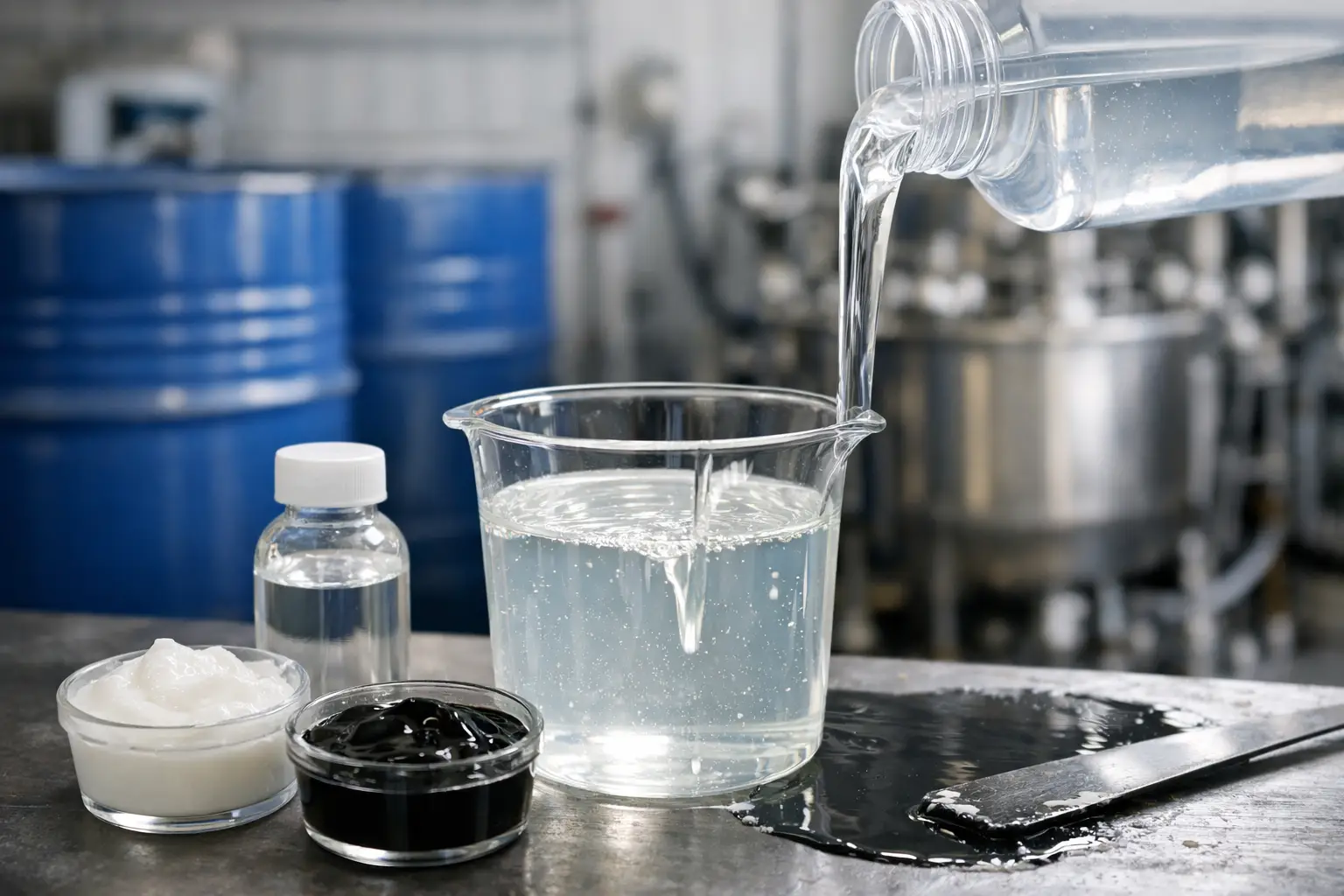
A liquid epoxy resin is not a finished solution by itself. Its value comes from how predictably it performs with the selected curing agent, fillers, pigments, diluents, and process conditions. For industrial buyers, the right resin grade affects far more than initial viscosity. It determines mixing efficiency, pot life, wetting, cure profile, mechanical strength, electrical performance, and the consistency of every production batch.
What Liquid Epoxy Resin Does in a Formulation
Liquid epoxy resin is a reactive oligomer containing epoxy functional groups, commonly based on bisphenol A diglycidyl ether chemistry. Before curing, it is a workable liquid that can be pumped, mixed, dispersed, impregnated, or applied as part of a coating, adhesive, casting, or composite system. After reaction with a compatible hardener, it forms a crosslinked thermoset structure.
That transformation gives epoxy systems their familiar combination of adhesion, chemical resistance, mechanical strength, and electrical insulation. However, no resin grade is universally best. A structural adhesive may prioritize bond strength and controlled flexibility. An electrical encapsulation compound may require low viscosity, low shrinkage, long working time, and stable dielectric properties. A protective coating may need pigment wetting, chemical resistance, and practical application viscosity.
For this reason, resin selection should begin with the end-use requirement and the curing system, not with a single specification on a data sheet.
Common Grades and Why Viscosity Matters
Industrial liquid epoxy grades such as CYD-127 and CYD-128 are widely used as base resins for coatings, adhesives, composites, laminates, tooling compounds, and electrical materials. These materials are generally selected for balanced epoxy functionality, processable viscosity, and dependable compatibility with standard curing-agent families.
Viscosity matters because it shapes what the plant can do with the material before gelation begins. Lower-viscosity resin can improve fiber wet-out in composite production, penetration into narrow electrical assemblies, and filler incorporation in casting compounds. It can also reduce the need for reactive diluents, which may be beneficial where formulators want to preserve crosslink density or reduce changes in final properties.
Higher-viscosity grades can still be appropriate when the formulation needs better sag resistance, higher molecular weight contribution, or a different balance of film build and handling. The practical question is not simply whether a resin is low viscosity. It is whether its viscosity remains suitable after pigments, silica, mineral fillers, flame retardants, or other additives are introduced.
Temperature must also be considered. Resin viscosity changes significantly between warehouse conditions, mixing temperatures, and application temperatures. A material that pumps easily in a warm production area may require drum warming or adjusted transfer equipment during winter receiving and storage.
Epoxy Equivalent Weight Is a Working Specification
Epoxy equivalent weight, often abbreviated EEW, indicates the amount of resin containing one equivalent of epoxy functionality. It is central to calculating the correct hardener ratio. A mismatch in stoichiometry can leave unreacted material, reduce chemical resistance, create surface tack, or produce a brittle cure.
Procurement teams should confirm that incoming material meets the required EEW range, not only a nominal product name. For repeat production, lot-to-lot control of EEW, viscosity, color, hydrolyzable chlorine, and moisture-related handling characteristics can be as important as the original qualification sample.
Matching Liquid Epoxy Resin With a Curing Agent
The curing agent defines much of the finished epoxy system. Amines can provide room-temperature or accelerated curing for coatings, adhesives, and flooring materials. Polyamides are often used where flexibility, adhesion, and practical coating application are needed. Acid anhydrides are frequently selected for electrical insulation, casting, impregnation, and high-performance composite applications because they can provide low viscosity, long pot life, and excellent electrical properties when cured under suitable conditions.
MTHPA, or methyltetrahydrophthalic anhydride, is a common anhydride hardener for epoxy systems requiring controlled thermal curing and high electrical insulation performance. Its low viscosity can support highly filled formulations and improve processing in encapsulation or casting operations. Anhydride systems generally require careful ratio control, moisture management, accelerator selection, and defined cure schedules.
This is where formulation fit matters more than purchasing resin and hardener separately on price alone. A resin that performs well with one amine may need different stoichiometry, acceleration, or temperature control when paired with an anhydride. Production teams should evaluate mixed viscosity, pot life at actual shop temperature, gel time, exotherm, cure completeness, and final performance together.
Key Checks Before Approving a Resin Supplier
A qualified liquid epoxy resin supplier should be able to support more than a basic product description. Buyers need clear technical information, consistent supply capability, and commercial terms that fit production schedules. Before approving a source, review the certificate of analysis requirements, packaging options, standard lead time, export documentation, storage guidance, and batch traceability.
For manufacturers using resin in high-volume production, warehouse inventory and shipment speed can prevent expensive line interruptions. It is also useful to work with a supplier that can provide related raw materials, including curing agents, accelerators, defoamers, dispersants, leveling agents, rheology modifiers, and fumed silica. Consolidating compatible materials can simplify purchasing, reduce freight coordination, and make technical communication more efficient.
Dahua New Materials supports this approach with direct manufacturer supply of MTHPA epoxy hardener and stocked liquid epoxy resins and formulation additives for industrial customers. For buyers, the advantage is not merely a broader catalog. It is the ability to source resin, hardener, and supporting materials with attention to how they will function in the same epoxy system.
Specifications Worth Confirming
A technical approval process should cover the properties most likely to affect plant performance and finished-product quality. At minimum, confirm the resin grade, epoxy equivalent weight, viscosity range, appearance, color, and packaging. Depending on the application, hydrolyzable chlorine, inorganic chlorine, moisture sensitivity, and crystallization behavior may also be relevant.
For electrical and electronics applications, verify the complete cured-system requirements rather than relying only on liquid resin data. Dielectric strength, volume resistivity, thermal stability, coefficient of thermal expansion, and resistance to thermal cycling are influenced by the resin-hardener-accelerator combination, filler package, and cure schedule.
For coatings and adhesives, application behavior deserves equal attention. Test pigment dispersion, substrate wetting, film appearance, recoat window, cure at expected ambient conditions, and resistance to the chemicals or service environment the product will face. A low raw-material price has limited value if the formulation needs excessive adjustment or causes inconsistent application.
Processing Practices That Protect Consistency
Liquid epoxy resin should be stored in sealed containers away from direct heat, moisture exposure, and contamination. Before use, inspect the material for clarity, color change, sediment, or crystallization. Some epoxy resins can crystallize during storage, especially at lower temperatures. Controlled warming may restore a uniform liquid state, but the procedure should follow the supplier’s handling guidance and avoid localized overheating.
During formulation, accurate weighing is essential. Resin and hardener ratio errors are one of the most common causes of incomplete curing and variable performance. Use calibrated equipment, record actual batch temperatures, and account for the effect of fillers and pigments on mixed viscosity. When adding fumed silica or other rheology modifiers, introduce them under sufficient shear and allow time for proper dispersion.
Air control also matters. Entrained air can create voids in castings, reduce dielectric reliability, and compromise adhesive bond lines. Depending on the system, vacuum mixing, vacuum deaeration, slower addition rates, or a suitable defoamer may be needed. The correct choice depends on batch size, filler loading, viscosity, and the sensitivity of the final application.
Buy for the Full System, Not Just the Drum
Liquid epoxy resin is a core industrial raw material, but its commercial value is measured in stable production results. The strongest purchasing decision connects resin grade, curing chemistry, additive package, incoming quality controls, packaging, inventory availability, and logistics requirements.
When a formulation team and procurement team evaluate those factors together, they can avoid costly rework after materials reach the plant. A dependable epoxy supply program should make the next batch easier to produce than the last: predictable in the mixer, controlled during cure, and ready to perform in service.