

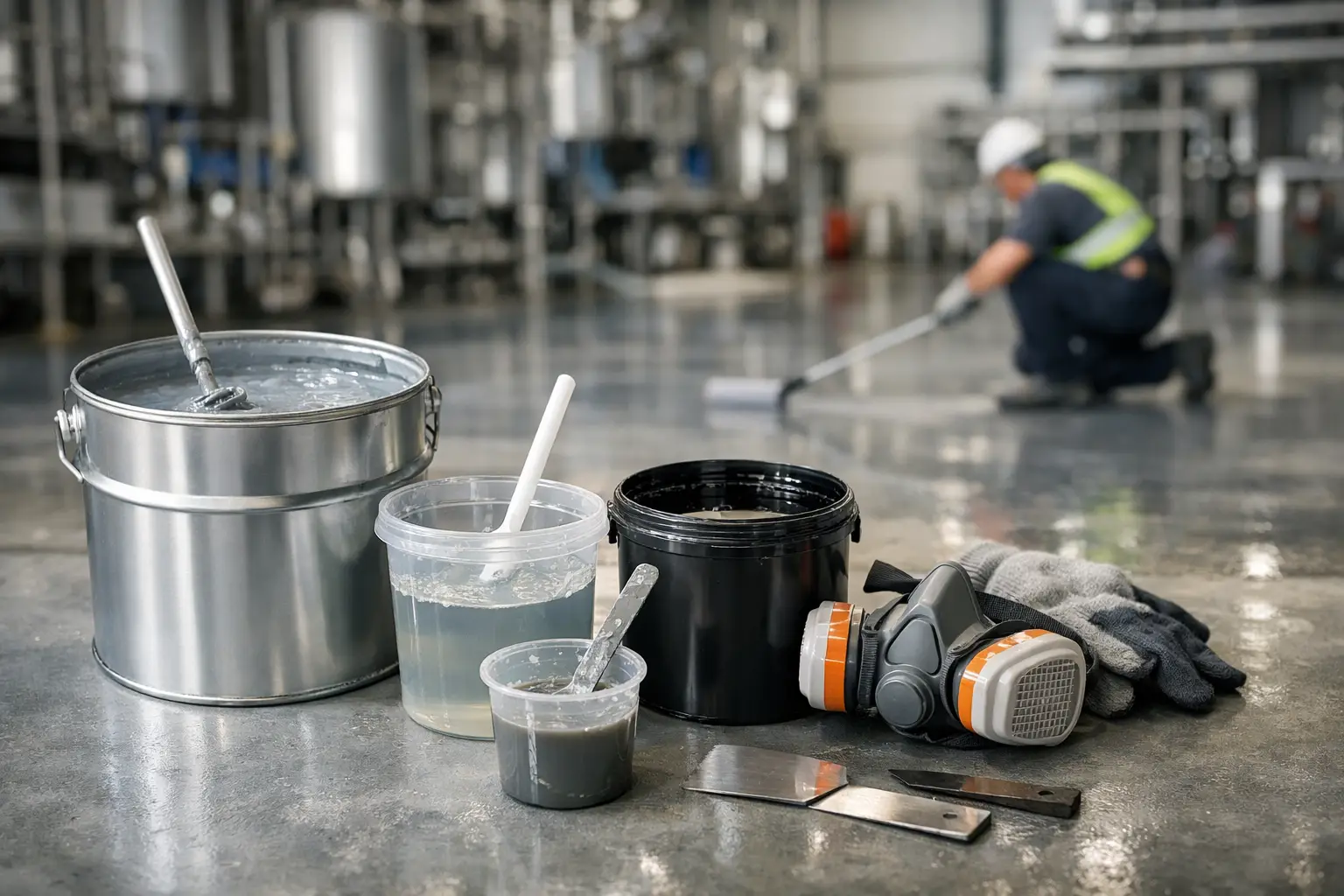
A production epoxy formula can look correct on paper and still fail on the line. Viscosity may rise after a raw-material change, pot life may shorten in summer, air may remain trapped in castings, or a coating may lose chemical resistance after an incomplete cure. This industrial epoxy formulation guide focuses on the decisions that control those outcomes: resin selection, curing-agent chemistry, stoichiometry, additives, processing, and supply consistency.
For industrial buyers and formulators, the target is not simply a cured epoxy. The target is repeatable performance at the required application speed, production temperature, and cost position. A high-strength adhesive, electrical encapsulant, solvent-free floor coating, and composite laminate all start with epoxy chemistry, but they require very different formulation priorities.
Start the Industrial Epoxy Formulation Guide With End Use
Define the finished product before selecting individual raw materials. The key question is which properties are non-negotiable after cure. Electrical potting compounds may prioritize dielectric strength, low ionic contamination, low shrinkage, and stable thermal performance. Structural adhesives need adhesion, toughness, gap filling, and controlled cure speed. Protective coatings often need workable viscosity, pigment acceptance, chemical resistance, and surface appearance.
Cure temperature matters as much as final performance. A formulation cured at room temperature must build properties with an amine or polyamide system designed for ambient reaction. A heat-cured electrical or composite system can use an anhydride hardener to obtain long pot life, low viscosity, and strong electrical insulation characteristics. These are not interchangeable choices. An anhydride system may provide excellent heat resistance and processing latitude, but it generally requires elevated-temperature curing and appropriate acceleration.
Also establish practical production limits early: allowable mix ratio, batch size, application method, usable pot life, line temperature, and storage conditions. Those limits prevent a laboratory formula from becoming a difficult manufacturing formula.
Select the Epoxy Resin Around Viscosity and Performance
Bisphenol A liquid epoxy resins remain the base of many industrial systems because they provide a useful balance of mechanical properties, adhesion, chemical resistance, and availability. Grades such as CYD-127 and CYD-128 can serve as standard starting points for coatings, adhesives, casting compounds, and composite formulations. Their epoxy equivalent weight and viscosity influence hardener demand, filler loading, flow, and final crosslink density.
Lower-viscosity resin is usually valuable when the system must wet glass fiber, penetrate narrow gaps, release bubbles, or accept high filler loading. However, reducing viscosity is not automatically a gain. Reactive diluents or lower-viscosity resins can alter shrinkage, chemical resistance, thermal properties, and cured hardness. The correct choice depends on whether processability or maximum thermal and mechanical performance is the greater constraint.
Specialty resins can be considered where the application justifies them. Novolac-type materials, including grades used for higher crosslink density, can improve heat and chemical resistance. The trade-off may be higher viscosity, greater brittleness, and a more demanding processing window. Formulators should evaluate the full resin-hardener package rather than expecting the resin alone to determine performance.
Use Epoxy Equivalent Weight for Accurate Mix Design
Do not set hardener levels only by a historical parts-by-weight ratio. Calculate from the resin epoxy equivalent weight and the curing agent’s active-hydrogen equivalent weight or anhydride equivalent weight. This is particularly important when changing resin grades, blending resin lots, adding reactive modifiers, or introducing a second curing agent.
A slight stoichiometric adjustment can be valid when testing indicates a performance benefit, but it should be intentional and documented. Excess hardener may affect moisture resistance, chemical resistance, color, or residual reactivity. Too little hardener can leave unreacted epoxy groups and reduce cure completeness. In electrical systems, incomplete cure can create a more serious long-term reliability issue than a visible cosmetic defect.
Match the Curing Agent to the Cure Schedule
The hardener establishes much of the formulation’s processing behavior. It controls gel time, pot life, exotherm, cure temperature, hardness development, flexibility, thermal resistance, and resistance to water or chemicals.
Amine curing agents are widely used for room-temperature and accelerated-cure epoxy systems. They are practical for industrial coatings, construction products, repair adhesives, and many bonding applications where a heated oven is not available. Their limitations can include short pot life, amine blush under humid conditions, and sensitivity to mixing accuracy.
Polyamide curing agents provide a more flexible cured network and can offer good adhesion and water resistance in protective coatings and marine-related uses. Compared with a fast amine system, they commonly provide a longer working time and more forgiving application behavior, though they may not deliver the same heat resistance or early hardness.
MTHPA, or methyltetrahydrophthalic anhydride, is suited to heat-cured epoxy systems requiring low viscosity, long pot life, good heat resistance, and excellent electrical insulation. It is commonly selected for electrical insulation, encapsulation, laminates, and composite applications. Since anhydride cure is slower without assistance, accelerators such as tertiary amines or imidazole-based materials are used to set a practical cure schedule.
Accelerator dosage requires careful control. Too little can leave the cure cycle uneconomical. Too much can sharply shorten pot life, increase exotherm in large castings, and reduce storage stability. Evaluate the complete profile: room-temperature viscosity change, gel time at process temperature, peak exotherm, and post-cure performance.
Build Additives Into the Formula, Not as Late Fixes
Additives are often treated as corrections after the primary resin-hardener system is selected. That approach can produce avoidable compatibility problems. Defoamers, dispersants, leveling agents, rheology modifiers, and fumed silica should be screened with the actual resin, hardener, pigments, and fillers proposed for production.
A defoamer that performs well in a clear casting resin may create surface defects in a pigmented coating. A rheology modifier can prevent filler settling and sag, but too much can reduce flow, trap air, and complicate pumping. Fumed silica is effective for building thixotropy in adhesives and non-sag coatings, yet it raises viscosity quickly and requires controlled dispersion.
For filled systems, particle size distribution and surface treatment deserve as much attention as filler type. High filler loading can reduce cost, shrinkage, and thermal expansion while improving dimensional stability. It can also increase viscosity, abrasion on processing equipment, and the risk of poor wet-out. The workable loading is determined by resin viscosity, mixing capability, desired flow, and the final electrical or mechanical requirement.
Control Mixing, Moisture, and Exotherm
Many epoxy failures originate in processing rather than formula design. Use a defined batch sequence and keep it consistent. Where fillers or pigments are used, disperse them fully into the resin side before adding the hardener. Introduce curing agents under controlled agitation to avoid excessive air entrainment. Vacuum deaeration is often justified for encapsulation, casting, and high-voltage electrical applications.
Moisture control is especially important for anhydrides, moisture-sensitive amines, and some fillers. Water can affect cure behavior, increase bubbles, and compromise electrical performance. Store materials in closed containers under the supplier’s recommended conditions, and confirm that partially used drums are properly resealed.
Exotherm becomes more critical as batch size and casting thickness increase. A formula that cures safely in a thin laboratory sample can overheat in a large pail or deep casting. Scale-up trials should measure internal temperature, not only oven temperature. If peak temperature is too high, options include reducing accelerator level, changing the cure ramp, lowering batch mass, using staged curing, or adjusting the reactive formulation balance.
Validate for Production, Not Just Initial Results
A useful qualification program measures both processing behavior and cured properties. Check initial viscosity, pot life, gel time, cure profile, hardness, adhesion, tensile or flexural properties where relevant, chemical exposure, and thermal testing appropriate to the application. Electrical compounds should additionally be assessed for dielectric behavior and insulation reliability under the expected service conditions.
Test with representative production equipment and substrates. The same formula can behave differently when applied by spray, roller, curtain coater, meter-mix equipment, or manual mixing. Lot-to-lot checks are also necessary when a product is supplied across multiple plants or customer sites.
Secure the Raw-Material Supply Before Release
An industrial formula is only as dependable as its raw-material specification and supply plan. Specify the approved resin grade, curing-agent grade, viscosity range, color requirement, moisture limit where applicable, packaging, and acceptable documentation. Establish whether equivalent substitutions are permitted, especially for hardeners and accelerators where a small chemistry change can shift the cure profile.
For high-volume programs, it is practical to consolidate compatible epoxy inputs with a supplier that can support both technical matching and shipment planning. Dahua New Materials manufactures MTHPA epoxy hardener with 45,000-ton annual capacity and also supplies liquid epoxy resins, curing agents, accelerators, and common formulation additives. That combination can simplify qualification, inventory planning, and repeat purchasing for manufacturers using multi-component epoxy systems.
The strongest formulation is one that runs predictably after the first production order, not just one that achieves a good test panel. Define the performance target, select chemistry that fits the actual cure process, verify it at production scale, and protect the result with controlled specifications and dependable supply.