

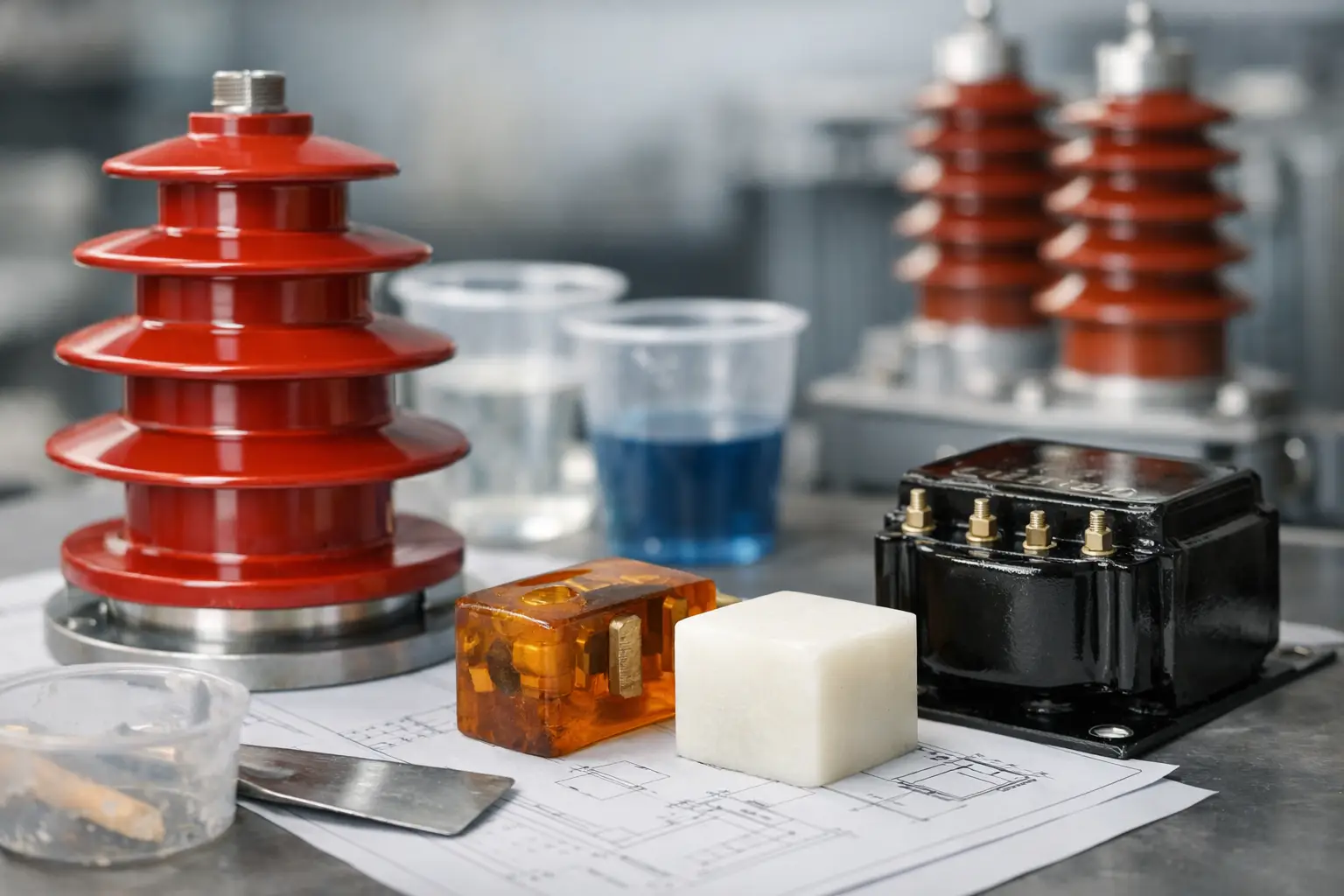
A transformer coil can pass an initial electrical test and still fail months later because the insulation system absorbed moisture, retained voids, or cured unevenly through a thick section. Epoxy resin electrical insulation is therefore not just a resin purchase. It is a material-system decision involving the base epoxy, curing agent, fillers, processing window, and the electrical and thermal demands of the finished part.
For manufacturers of cast components, bushings, dry-type transformers, circuit boards, sensor housings, and high-voltage assemblies, the goal is consistent dielectric performance at production scale. A formulation must flow into complex geometry, release air, cure predictably, resist heat and humidity, and maintain adhesion during thermal cycling. The correct balance depends on the end use.
How Epoxy Resin Electrical Insulation Performs
Cured epoxy forms a tightly crosslinked thermoset network. This network provides high electrical resistance, good dielectric strength, strong adhesion to many substrates, and useful resistance to chemicals and moisture. These properties make epoxy a standard material for encapsulation, potting, laminates, coil impregnation, and electrical casting.
Electrical insulation performance is usually evaluated through more than one number. Dielectric strength indicates the voltage a material can withstand before breakdown under specified test conditions. Volume resistivity measures the material’s resistance to current flow through its bulk. Dielectric constant and dissipation factor matter where frequency-dependent electrical behavior affects equipment performance. Tracking resistance, comparative tracking index, partial-discharge behavior, and arc resistance may also be relevant for higher-voltage applications.
A high dielectric-strength result from a small laboratory plaque does not guarantee field performance. Entrapped air, filler dispersion, moisture, resin-rich and filler-rich areas, sharp conductor edges, and inadequate cure can all create local stress points. In high-voltage casting, partial discharge can gradually damage the insulation long before a complete breakdown occurs.
Select the Resin and Hardener as a System
Liquid bisphenol A epoxy resins such as CYD-127 and CYD-128 are widely used starting points for electrical formulations because they offer manageable viscosity, good mechanical strength, and broad compatibility with curing agents and additives. Their epoxy equivalent weight, viscosity, color, and impurity control should be considered alongside the intended processing method.
The curing agent determines much of the final thermal and electrical profile. For heat-cured electrical castings, MTHPA is a common anhydride hardener choice. It is valued for low viscosity, long pot life, and the ability to produce cured epoxy systems with strong electrical insulation and heat resistance. These characteristics are particularly useful where resin must penetrate windings or fill molds without premature viscosity increase.
Anhydride systems generally require elevated-temperature curing and are often used with an accelerator. That adds a processing advantage and a control requirement. The accelerator level, gel time, cure ramp, and post-cure schedule must be matched carefully. Too much acceleration can shorten working time and increase exotherm. Too little can leave an incomplete cure, reducing thermal and electrical reliability.
Amine-cured epoxies are suitable when room-temperature or lower-temperature cure is necessary, including some potting, adhesive, and repair applications. However, their pot life, moisture sensitivity, color stability, thermal performance, and final dielectric properties may differ materially from anhydride-cured systems. There is no universal best hardener. The practical choice follows the production process and service environment.
Fillers Control Cost, Heat, and Electrical Reliability
Most industrial electrical insulation compounds are filled systems. Properly selected mineral fillers can lower thermal expansion, improve dimensional stability, support heat dissipation, reduce cost per unit volume, and improve resistance to cracking in thick castings. Silica is frequently used because it can support mechanical and electrical performance when particle size, surface treatment, and loading are optimized.
Filler selection also creates trade-offs. Higher filler loading may reduce shrinkage and lower the coefficient of thermal expansion, which helps protect conductor interfaces during temperature changes. But it also raises viscosity, complicates mold filling, and can make degassing more difficult. A compound that is too viscous may leave voids around windings, terminals, and narrow channels.
Surface-treated fillers often improve compatibility with the epoxy matrix. Good dispersion is essential because agglomerates can act as electrical weak points and interfere with smooth flow. Fumed silica can provide rheology control where sag resistance is needed, but excessive use can sharply increase viscosity. Defoamers, dispersants, and leveling additives should be evaluated at the lowest effective level because additive interactions can affect cure behavior and dielectric results.
For applications where heat removal is a priority, thermally conductive fillers may be considered. The key distinction is whether electrical isolation must remain high. Some conductive thermal fillers are unsuitable for an insulation system, while electrically insulating thermal fillers can provide a more appropriate balance. The finished formulation should be tested rather than judged only by individual raw-material data sheets.
Process Control Is Part of Electrical Insulation
The best epoxy formulation cannot compensate for poor handling. Raw materials should be protected from moisture, especially anhydride curing agents and hygroscopic fillers. Storage temperature, container sealing, and material conditioning before use affect viscosity and water content. In humid production environments, this discipline becomes more important.
Accurate stoichiometry is equally important. Resin-to-hardener ratio should be based on epoxy equivalent weight and anhydride equivalent weight, then verified through formulation trials. Using a convenient weight ratio without confirming equivalents can leave excess resin or hardener in the cured network. The result may be lower glass transition temperature, reduced chemical resistance, or unstable electrical properties.
Mixing should produce uniform distribution without introducing unnecessary air. For critical castings, vacuum mixing and vacuum degassing are often justified. Vacuum impregnation may be needed for windings or porous assemblies where air must be removed before resin enters the available space. Mold design, casting temperature, and fill rate should be controlled to avoid air entrapment at corners and around conductor transitions.
Cure schedules deserve the same attention as material selection. Thick sections produce more heat during reaction than thin coatings or laminates. A fast cure cycle that works on a small sample can create excessive exotherm, shrinkage stress, or cracking in a large casting. A staged cure and controlled post-cure can provide better conversion and a more uniform network through the full part thickness.
Testing Epoxy Resin Electrical Insulation Before Release
Qualification testing should reflect actual service conditions. Dielectric strength testing, such as ASTM D149 or IEC 60243 methods, is useful but should be paired with volume resistivity measurements, moisture exposure, thermal aging, and adhesion checks. For high-voltage components, partial-discharge testing and thermal-cycle evaluation can reveal issues that conventional dielectric tests do not capture.
Production release testing should also be practical. Incoming checks may include viscosity, color, acid value or anhydride content where applicable, gel time, and moisture control. Finished compounds can be monitored for density, flow behavior, cure profile, hardness, and key electrical properties. A controlled reference panel or casting helps detect variation before it reaches an electrical assembly line.
Requirements should be written around the component, not only the raw material. A coil impregnation resin needs penetration and long working life. A heavily filled casting compound needs low shrinkage and controlled exotherm. An outdoor enclosure may require stronger weathering and tracking performance. Aligning the test plan to the application prevents unnecessary cost and reduces qualification risk.
Supply Planning for Electrical Formulators
For recurring production, stable chemistry and stable logistics are connected. Changes in resin viscosity, hardener reactivity, filler treatment, or additive supply can force revalidation and disrupt process settings. Procurement teams should work with formulation and quality teams to define acceptable ranges, lot documentation needs, packaging formats, lead times, and safety stock levels.
Dahua New Materials supports industrial buyers with direct-manufacturer MTHPA supply, stocked liquid epoxy resins, curing agents, accelerators, and formulation additives. For manufacturers consolidating multiple epoxy inputs, sourcing compatible materials through one experienced supplier can simplify technical matching, shipment planning, and batch-to-batch coordination.
The most reliable insulation system is the one that has been validated in the actual part, under the actual cure cycle, with raw materials that can be supplied consistently. Start with the electrical target, build the formulation around the manufacturing process, and treat every void, ratio, and cure parameter as part of the insulation design.