

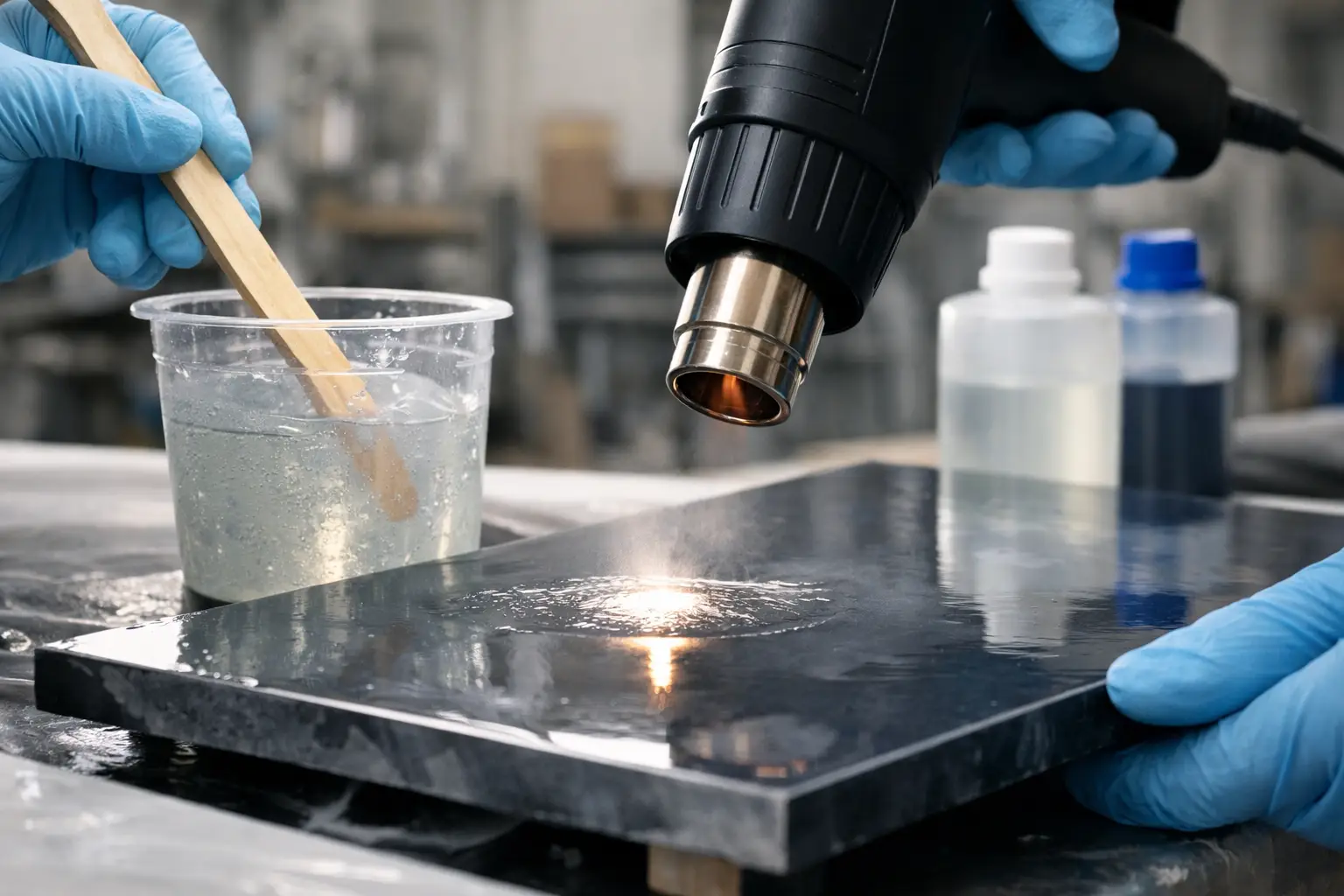
A cure schedule that works in a 1 kg laboratory batch can fail when moved to a 500 kg mixing vessel, a thick casting, or a fast coating line. For manufacturers asking how to optimize epoxy cure, the practical objective is not simply to make the system react faster. It is to achieve repeatable conversion, target properties, workable processing time, and stable output at the lowest practical production risk.
Epoxy curing is a balance among resin chemistry, hardener selection, mixing quality, thermal history, part geometry, and the operating conditions on the production floor. Changing one variable can improve one result while creating another problem. More heat may shorten cycle time, for example, but can reduce pot life, raise exotherm, increase shrinkage stress, or cause surface defects.
Start With Stoichiometry, Not Temperature
The correct resin-to-hardener ratio is the foundation of cure optimization. It should be calculated from epoxy equivalent weight and hardener equivalent weight, then verified against the supplier’s recommended formulation range. Weight ratio alone is not a universal cure rule because different epoxy resins and curing agents have different functional values.
An off-ratio formulation may appear hard after processing but still deliver weak chemical resistance, reduced glass transition temperature, poor electrical performance, or an oily surface. Excess amine can contribute to blush and moisture sensitivity. Excess epoxy can leave unreacted functionality and reduce network development. With anhydride-cured systems, the accelerator level and hydroxyl content may also influence the effective reaction path.
For routine manufacturing, control ratio by calibrated weight rather than volume whenever possible. Confirm load-cell accuracy, container tare settings, and transfer losses. In high-volume production, a small ratio drift repeated across many batches can create substantial variation in gel time and finished-part performance.
Match the Hardener to the Process Window
A hardener should be selected for the required cure temperature, pot life, viscosity, end-use environment, and application method. Fast-reacting amine systems are useful where room-temperature cure or rapid handling strength is needed, but they can provide limited working time and may generate higher exotherm in larger masses.
Anhydride curing agents such as MTHPA are often selected for electrical insulation, casting, laminates, and heat-cured composite applications because they offer low viscosity, long pot life, and strong electrical and thermal properties when properly formulated. They generally require elevated-temperature curing and appropriate acceleration. That trade-off is often favorable when manufacturers need controlled processing rather than immediate ambient cure.
Polyamide hardeners may fit protective coatings and adhesives requiring flexibility and tolerance for less-than-perfect surface conditions. The right choice depends on the full operating window, not just the initial cure speed.
Control the Cure Profile Across the Entire Part
Cure temperature determines reaction rate, but the temperature set on an oven is not necessarily the temperature inside the epoxy. Thick sections, insulated molds, filled compounds, and large mixed batches can generate internal heat as the reaction accelerates. This exotherm can create a hotter core than the programmed oven temperature.
Measure actual material temperature with representative thermocouples during trial runs. For castings and encapsulation compounds, monitor the center of the largest section as well as the surface. A profile that is safe for a thin electrical laminate may overheat a deep potting compound.
A staged cure is often more reliable than applying maximum heat immediately. A lower-temperature gel stage can allow the material to flow, wet substrates, and release air before the network tightens. A subsequent higher-temperature stage then develops conversion and heat resistance. Post-curing may be necessary to reach the specified glass transition temperature and final chemical resistance.
The best profile is application-specific. Under-curing leaves a weak or incomplete network. Overly aggressive heating can cause voids, cracking, discoloration, print-through, and internal stress. Production teams should document ramp rate, dwell time, mold temperature, oven loading, and cooling conditions, not only the final setpoint.
Optimize Mixing Before Adding More Accelerator
Poor dispersion is commonly mistaken for slow or inconsistent chemistry. If resin, hardener, pigments, fillers, or accelerators are not uniformly distributed, one area of the part can cure differently from another. The result may be soft spots, gloss variation, uneven adhesion, localized brittleness, or inconsistent dielectric properties.
Mixing equipment must suit the formulation viscosity and batch size. Low-viscosity systems may need controlled agitation that avoids vortexing. Highly filled compounds may require higher shear and a defined addition sequence. Scraping vessel walls and the bottom of the mixing tank is essential, particularly when using fumed silica, mineral fillers, or pigments that can remain concentrated in dead zones.
Air management is equally important. Entrained air can expand during heat cure and form voids in coatings, castings, and encapsulation. Vacuum mixing, vacuum deaeration, slower addition rates, and suitable defoamers can reduce this risk. However, excessive vacuum or uncontrolled agitation can strip volatile components or create unnecessary processing delays, so parameters should be set through trials rather than assumed.
Use Accelerators Carefully
Accelerators are effective tools for shortening gel time, reducing cure temperature, or increasing throughput. They are not a substitute for correct stoichiometry or a sound thermal profile. In anhydride systems, accelerator type and dosage strongly affect latency, reaction speed, peak exotherm, and final network structure.
Start with a controlled dosage range and evaluate gel time, peak temperature, hardness development, glass transition temperature, electrical properties, and storage stability. A higher accelerator level may improve line speed but can sharply reduce pot life. This may be unacceptable for long impregnation cycles, large pours, or applications requiring extended wet-out time.
Also consider how the accelerator is introduced. Pre-dispersing it into a compatible resin portion can improve consistency, while direct addition into a high-viscosity filled batch may create local concentration differences. Keep accelerator storage conditions stable and verify incoming material identity before use.
Manage Moisture, Contamination, and Raw Material Temperature
Epoxy systems are sensitive to the conditions surrounding them. Moisture can interfere with some cure reactions, contribute to foaming, and affect electrical insulation performance. Amine-cured surfaces can develop carbamate blush when exposed to humid air and carbon dioxide, reducing intercoat adhesion unless the surface is properly cleaned.
Store resin, hardener, fillers, and additives in dry, temperature-controlled conditions appropriate to their specifications. Dry hygroscopic fillers when required. Avoid returning unused mixed material to fresh inventory. Use dedicated hoses, pumps, and containers to prevent contamination by solvents, water, plasticizers, or the wrong curing agent.
Raw material temperature also changes viscosity and reaction behavior. A cold resin may mix poorly and trap air; an overly warm hardener can shorten usable life before processing begins. Set an acceptable material-temperature range at receiving, storage, and mixing stages. This is particularly valuable when plants operate across seasonal temperature changes.
Validate Cure With Performance Data
Hardness alone does not prove a complete or optimized cure. A production validation plan should connect cure conditions to the properties that matter for the application. For a protective coating, that may include adhesion, solvent resistance, impact performance, and appearance. For electrical encapsulation, it may include dielectric strength, volume resistivity, thermal cycling, and void content. Structural adhesives and composites may require lap shear, flexural properties, glass transition temperature, and fatigue testing.
Differential scanning calorimetry can help identify residual reaction and compare cure schedules. Dynamic mechanical analysis is useful for assessing glass transition temperature and network development. Gel-time testing, viscosity tracking, and exotherm monitoring are practical in-process controls. The most useful program combines laboratory measurements with production-scale trials, because mass and heat transfer change substantially with scale.
When qualifying a new resin, hardener lot, filler source, or accelerator, do not change several variables at once. Keep a control batch, document the formulation and processing conditions, and use a small design of experiments to isolate the effect of temperature, ratio, and accelerator level. This shortens troubleshooting when performance moves outside specification.
Build a Cure Window That Procurement Can Support
A technically sound cure process still needs reliable raw-material supply. Lot-to-lot consistency, documented specifications, inventory availability, and lead time all affect a plant’s ability to maintain validated parameters. If a substitute hardener requires a different ratio or cure profile, it should be treated as a formulation change rather than a purchasing-only decision.
Dahua New Materials supports industrial formulators with direct-manufacturer MTHPA supply, stocked epoxy resins, curing agents, accelerators, and functional additives that can be matched to a complete epoxy system. Consolidating compatible materials can simplify qualification, incoming inspection, and production planning.
The most effective cure optimization program is a controlled manufacturing discipline: specify the chemistry, measure the real thermal profile, protect the materials from contamination, and verify results against end-use performance. When those controls are in place, faster cycles and dependable properties become achievable targets rather than costly trial-and-error.