

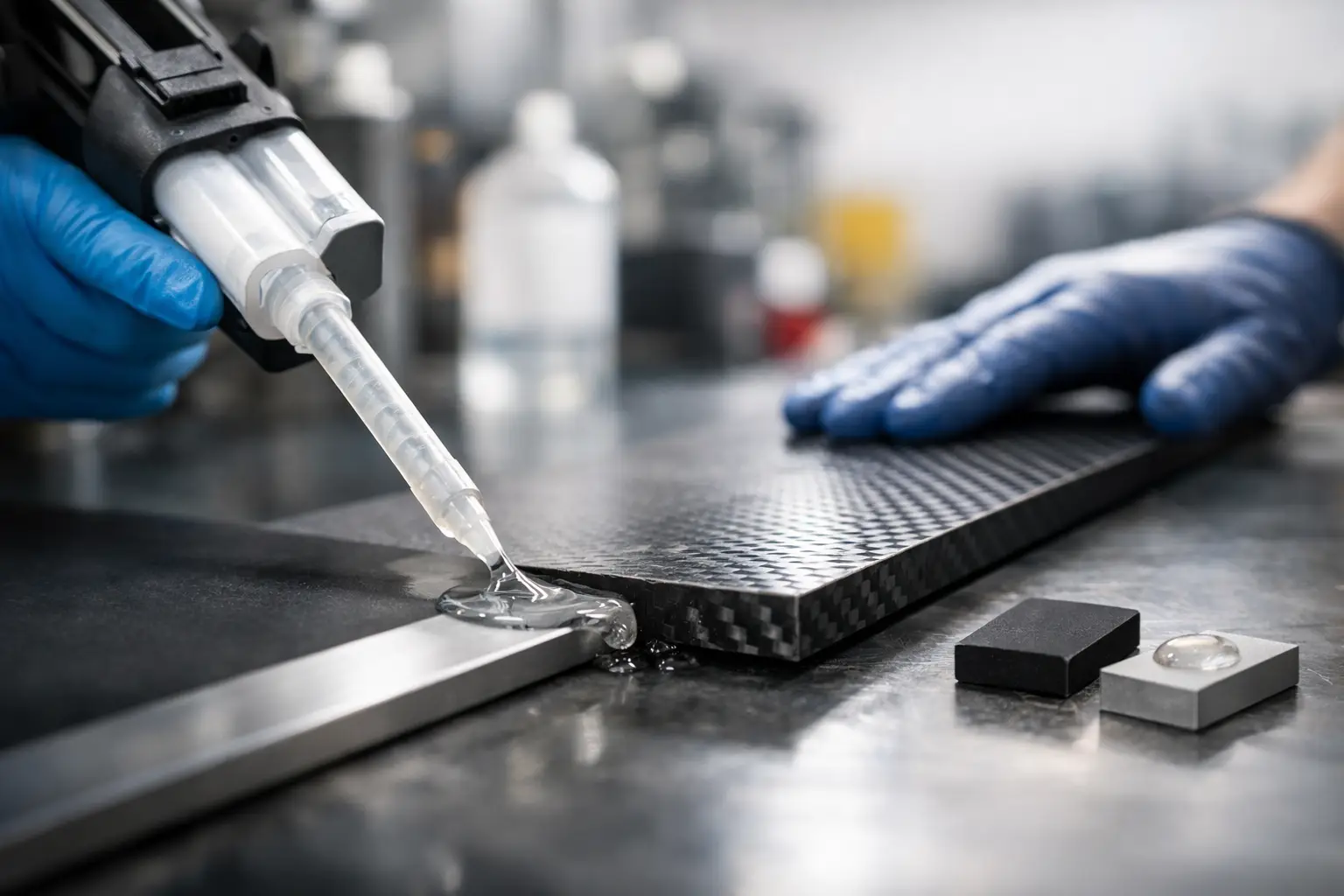
An epoxy bond can show acceptable initial strength and still fail in service because the interface was contaminated, chemically mismatched, or cured under the wrong conditions. For industrial formulators and production teams, knowing how to improve epoxy adhesion means controlling the complete bonding system: substrate condition, resin and curing-agent chemistry, application parameters, and cure schedule. A stronger adhesive alone cannot compensate for an unstable surface or an incomplete cure.
Start With the Actual Failure Mode
Before changing resin grade or adding a promoter, determine where the failure occurs. Adhesive failure leaves a relatively clean substrate surface after separation, indicating weak interfacial bonding. Cohesive failure occurs within the cured epoxy layer, which often means interfacial adhesion is stronger than the bulk material. A mixed failure can point to inconsistent surface preparation, uneven adhesive thickness, or variable cure.
This distinction matters commercially as well as technically. Replacing an entire epoxy system when the root cause is silicone transfer from a molding operation adds cost without solving the problem. Conversely, repeated surface-treatment changes will not fix a formulation with inadequate flexibility, poor wet-out, or a cure profile that leaves residual reactive groups.
Review failed parts against substrate lot, cleaning method, storage time, bond-line thickness, ambient humidity, mixing ratio, cure temperature, and pressure. For coated steel, aluminum, glass-filled composites, and electrical laminates, a small process shift can change surface energy enough to affect adhesion significantly.
How to Improve Epoxy Adhesion at the Surface
Surface preparation is usually the highest-value improvement because epoxy must first wet the substrate before it can form durable mechanical and chemical attachment. Oils, release agents, fingerprints, dust, corrosion products, and absorbed moisture all interfere with wetting. A surface may look clean and still carry a thin contamination layer that is sufficient to cause bond loss.
Clean for the Contaminant You Have
Choose cleaning based on the contaminant and substrate rather than using a universal solvent wipe. Oil and machining fluids may require alkaline cleaning or a validated solvent process. Oxides on aluminum and steel may require abrasion, conversion treatment, or controlled chemical treatment. Plastics often need detergent cleaning followed by plasma, corona, flame treatment, or a compatible primer.
Avoid transferring contamination during the cleaning step. Reused wipes, poorly maintained wash baths, and unfiltered compressed air are frequent sources of recontamination. After preparation, limit handling and define a maximum time between treatment and adhesive application. Freshly treated metal and high-energy plastic surfaces can lose bondability during storage.
Create a Stable Bonding Profile
Mechanical abrasion improves adhesion by removing weak boundary layers and creating a profile that the liquid epoxy can penetrate. The objective is not simply a rougher surface. Excessively coarse abrasion can trap air, hold cleaning residues, or create stress concentrations. The best profile depends on the adhesive viscosity, the substrate, and the required bond-line thickness.
For metals, controlled abrasion followed by thorough cleaning is commonly effective. For composites, aggressive sanding can expose fibers or damage the matrix, so use a process validated for the specific laminate. On smooth, low-surface-energy plastics such as polypropylene or polyethylene, abrasion alone is often insufficient. Surface activation or a primer is normally required.
Match Resin, Hardener, and Additives to the Job
Epoxy adhesion depends on wetting, cure shrinkage, crosslink density, toughness, and the chemical affinity between the cured network and the substrate. A formulation that performs well in rigid electrical encapsulation may not be suitable for a steel-to-aluminum joint exposed to impact and thermal cycling.
Lower-viscosity liquid epoxy resins can improve wetting and penetration into a prepared surface profile. Grades such as CYD-127 and CYD-128 are widely used starting points when formulators need balanced processing and mechanical properties. However, lower viscosity should not be treated as an automatic solution. Reactive diluents may improve flow but can reduce heat resistance, chemical resistance, or long-term durability if used without careful formulation control.
The curing agent sets much of the final network structure. Anhydride systems, including MTHPA-based systems, are often selected for electrical insulation, laminates, and encapsulation where low viscosity, long pot life, thermal performance, and electrical properties are required. They typically need elevated-temperature curing and appropriate acceleration. If the specified cure cycle is not achieved throughout the part, surface or interface properties may be inconsistent even when the exterior appears hard.
Amine and polyamide curing agents offer different practical advantages. Some amine-cured systems provide fast room-temperature cure and strong chemical bonding to properly prepared substrates. Polyamide-cured systems can provide improved flexibility and tolerance in certain coating and adhesive applications. The correct choice depends on the substrate, production window, service temperature, humidity exposure, and flexibility requirement.
Adhesion promoters can be valuable when the substrate chemistry demands them. Silane coupling agents are frequently considered for glass, mineral-filled composites, and certain metal oxide surfaces. Toughening modifiers may improve peel resistance and thermal-cycle performance by reducing brittleness. Fumed silica and rheology modifiers can prevent sag and control bond-line placement, but excessive loading can reduce wetting and make air removal more difficult. Every additive should be evaluated against viscosity, pot life, cure behavior, and finished-part requirements.
Control Mixing, Application, and Cure
A well-designed formulation can lose adhesion through poor shop-floor control. Metering accuracy is essential, particularly for systems with a narrow stoichiometric range. Too little curing agent may leave an under-cured network, while too much can change crosslink structure, increase residual polarity, or reduce heat resistance. Calibrate dispensing equipment and verify actual output ratios, not only programmed settings.
Mixing must be sufficient to create a uniform system without entraining excessive air. For filled formulations or high-viscosity systems, vacuum mixing or post-mix degassing may be justified. Entrapped air near the interface reduces effective contact area and can become a moisture pathway during thermal or electrical service.
Apply the epoxy within its useful working life. Pot life is not a guarantee that viscosity, wetting, and flow remain constant until the final minute. As reaction advances, the material may no longer penetrate microtexture or level effectively. Production teams should define an application window based on viscosity and bond performance, not only gel time.
Cure temperature must be measured at the bond line or part core when assemblies have significant mass, insulation, or heat-sink effects. An oven setpoint is not the same as part temperature. Fast ramp rates can create internal stress, while inadequate dwell can leave the network incompletely cured. Where the substrate and epoxy have different coefficients of thermal expansion, a staged cure or post-cure may improve retained adhesion by reducing stress accumulation.
Test for Service Conditions, Not Just Initial Strength
A lap-shear result measured one day after cure is useful, but it does not fully predict field performance. Select tests that reflect the actual duty cycle: peel or cleavage loading for flexible joints, thermal cycling for dissimilar materials, humidity exposure for electrical assemblies, and chemical immersion for process equipment or protective coatings.
Examine the fracture surface after each test. A high numerical strength result with clean adhesive failure may still indicate an interface that will be vulnerable after moisture or heat exposure. Track both bond strength and failure appearance across material lots and production shifts. This builds a more useful quality record than a single pass-fail value.
For new formulations, use a small design-of-experiments approach rather than changing several variables at once. Compare surface treatment, resin viscosity, hardener type, promoter level, and cure schedule in controlled combinations. The resulting data helps purchasing and technical teams identify which inputs are critical and where a lower-cost option is genuinely equivalent.
Build Adhesion Into Material Procurement
Reliable adhesion requires consistent raw-material properties as much as controlled processing. Resin epoxy equivalent weight, hardener reactivity, additive compatibility, viscosity, moisture condition, and lot-to-lot handling behavior should be defined in the purchasing specification. Suppliers should be able to support stable bulk availability and technical matching when a formulation requires a specific cure profile or application viscosity.
Dahua New Materials supports industrial epoxy systems with MTHPA hardener manufacturing capacity and stocked resin, curing-agent, and additive options for formulation work. For production programs, consolidating compatible epoxy inputs can simplify qualification and reduce the variability introduced by fragmented sourcing.
The most durable epoxy bond is usually created before the parts enter the cure oven. Treat the interface as a controlled manufacturing variable, verify it with service-relevant testing, and let the required performance determine the chemistry and process window.