

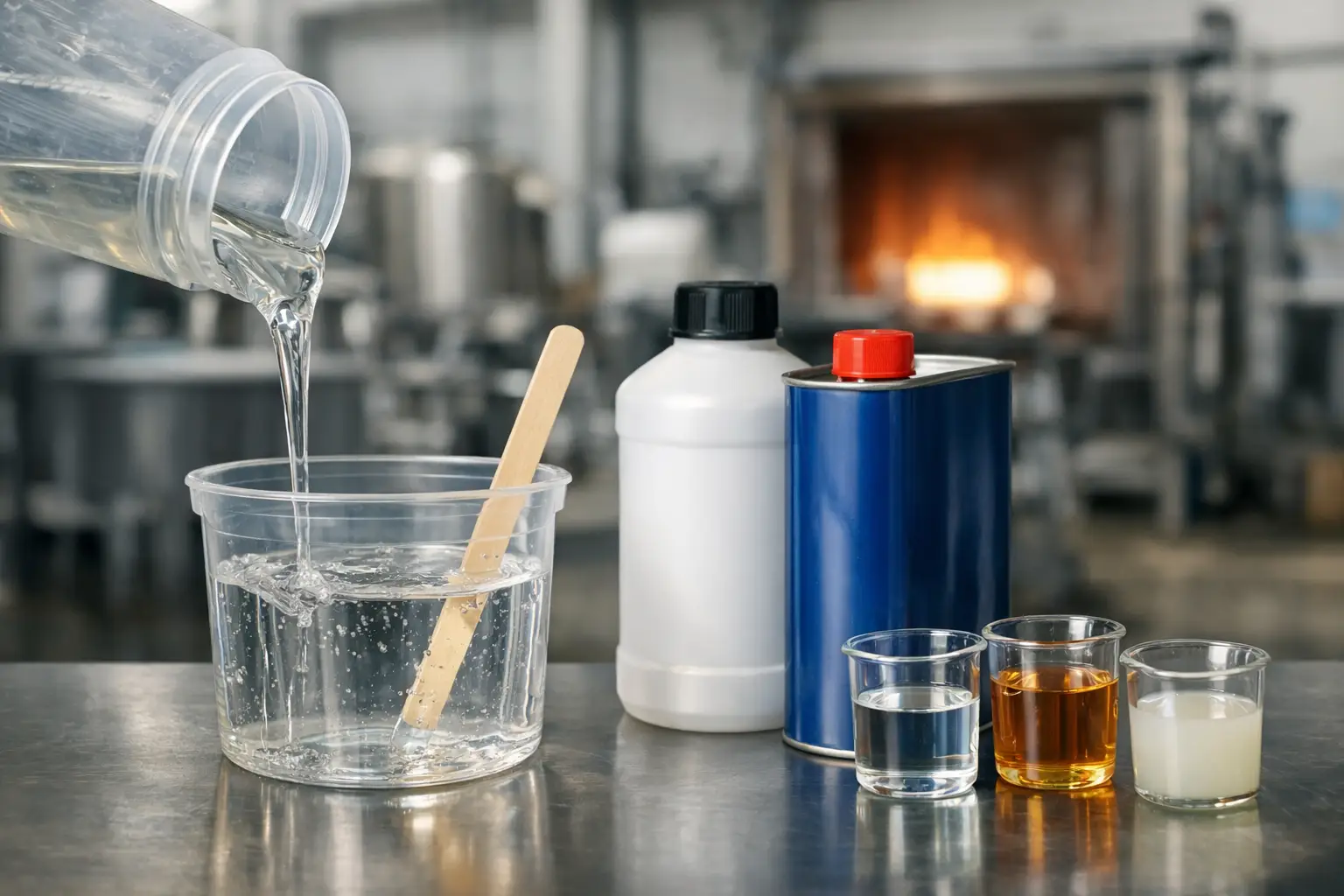
An epoxy resin hardener is not simply an additive that makes resin solid. It determines how an epoxy system processes on the production line, how long it remains workable, what cure schedule it requires, and how the finished part performs under heat, chemicals, load, or electrical stress. For industrial buyers, selecting the hardener is therefore both a formulation decision and a supply-risk decision.
A resin grade may be stable across multiple applications, while the curing agent must be matched closely to the intended process. The correct selection can provide low viscosity and long pot life for casting, fast room-temperature cure for field-applied coatings, or high thermal and electrical performance for encapsulation. The wrong selection can create incomplete cure, excessive exotherm, poor adhesion, inconsistent batch quality, or avoidable production delays.
What an Epoxy Resin Hardener Does
Epoxy resins contain reactive epoxy groups that need a curing agent to form a crosslinked polymer network. The hardener reacts with these groups during curing, changing a liquid or semi-solid formulation into a durable thermoset material. This network gives epoxy its characteristic strength, adhesion, chemical resistance, insulation properties, and dimensional stability.
The cure reaction is not identical for every hardener family. Amines generally react directly with epoxy groups and can cure at room temperature or with moderate heat. Anhydrides usually require elevated temperature and, in many systems, an accelerator. Polyamides offer useful flexibility and adhesion, particularly in protective coatings and adhesives. Each chemistry produces a different balance of processing window and end-use performance.
For this reason, hardener choice should begin with the application requirements, not with a request for the lowest unit price. A lower-cost curing agent can become expensive if it slows production, raises rejection rates, or requires a more demanding cure cycle.
Main Epoxy Hardener Families
Anhydride Hardeners for Electrical and Heat-Resistant Systems
Anhydride curing agents are widely used where low viscosity, long pot life, low shrinkage, and strong electrical insulation are required. They are common in electrical casting, electronics encapsulation, composites, laminates, powder coatings, and high-performance industrial components.
MTHPA, or methyltetrahydrophthalic anhydride, is a widely used liquid anhydride epoxy hardener. Its low viscosity supports high filler loading and easier mixing, which is valuable in filled electrical compounds and casting formulations. It also enables a relatively long working life before heat curing, helping manufacturers process larger batches or complex molds with more control.
The trade-off is that anhydride systems normally need a controlled heat cure. They are not the default choice for applications that must set rapidly at ambient temperature. Formulators must also control the resin-to-hardener ratio, accelerator level, moisture exposure, and cure schedule. When those variables are properly managed, anhydride-cured epoxies can deliver excellent thermal stability, dielectric properties, and long-term reliability.
Amine Hardeners for Ambient or Faster Cure
Aliphatic, cycloaliphatic, and aromatic amine curing agents are selected when faster reactivity or room-temperature curing is needed. They are common in flooring, civil engineering, corrosion-protection coatings, structural adhesives, and repair materials.
Aliphatic amines can provide fast cure but may have shorter pot life, stronger odor, and higher sensitivity to moisture or carbon dioxide during application. Cycloaliphatic amines are often used where better color stability, chemical resistance, and film appearance are needed. Aromatic amines can offer high heat resistance, although processing requirements and regulatory considerations must be evaluated carefully.
For a production manager, the key question is whether speed or working time has greater value. A fast-curing amine may improve throughput for a small-batch coating operation. For a large composite infusion or a complicated adhesive assembly, a longer pot life may be worth more than a rapid initial cure.
Polyamide Hardeners for Tough, Adhesive Coatings
Polyamide curing agents are frequently used in epoxy coatings, marine maintenance systems, primers, and flexible adhesives. They generally provide good adhesion, toughness, water resistance, and a forgiving application profile. Their lower reactivity can support longer pot life and practical field use.
Compared with highly crosslinked anhydride or certain amine systems, polyamide-cured epoxies may have lower heat resistance and chemical resistance in demanding service. They are a practical choice when flexibility and adhesion are priorities, but they should be evaluated carefully for high-temperature immersion, electrical encapsulation, and tightly specified industrial environments.
Match the Hardener to the Cure Process
A technically suitable epoxy resin hardener can still fail in production if the cure process is not realistic for the plant. Formulators should define whether curing occurs at ambient temperature, in a heated oven, through staged heating, or under pressure in a molded part.
Anhydride systems are particularly dependent on heat profile. A controlled pre-gel stage followed by a higher-temperature post-cure can reduce internal stress and support full conversion. Curing too quickly can trap bubbles, increase exotherm, and create uneven properties through thick sections. Curing too slowly or below the required temperature can leave unreacted groups that reduce chemical resistance and electrical reliability.
Amine systems require their own controls. Humidity, substrate temperature, mix ratio, and coating thickness can affect cure behavior. For coatings, a surface that appears dry is not proof of full cure. Through-cure and crosslink density should be tested against the actual service requirements.
Accelerators can improve cure speed in anhydride systems, but more accelerator is not always better. Excessive levels may shorten pot life, increase peak exotherm, alter storage stability, or affect final electrical properties. Accelerator selection should be validated alongside the resin, hardener, fillers, and target curing conditions.
Use Stoichiometry, Not Guesswork
Mix ratio is a chemical requirement, not a convenience setting. The correct ratio depends on epoxy equivalent weight, hardener equivalent weight, functionality, and the formulation’s intended stoichiometry. A hardener supplier should be able to provide the key technical data needed to calculate the starting ratio.
In practice, formulations may be adjusted slightly to improve flexibility, surface cure, or specific processing behavior. Those adjustments should follow lab testing rather than informal production changes. Over-hardening or under-hardening can reduce crosslink quality even when the mixture eventually becomes solid.
For filled systems, verify whether the ratio is expressed against the resin portion only or against the total compound. Fillers, pigments, defoamers, dispersants, rheology modifiers, and fumed silica change viscosity and processing, but they do not replace the reactive balance between resin and hardener.
Performance Factors That Should Drive Selection
Industrial teams should review the hardener through the full application profile. Viscosity affects pumping, metering, filler incorporation, wetting, and bubble release. Pot life affects batch size, waste, and the time available for dispensing or impregnation. Gel time affects line speed and mold availability.
The cured system must then meet the end-use requirements. These may include glass transition temperature, tensile and flexural performance, peel strength, chemical resistance, moisture resistance, dielectric strength, volume resistivity, thermal cycling resistance, and flame-retardant formulation compatibility. No single epoxy hardener is best across every measure.
For example, an electrical encapsulation compound may prioritize low viscosity, low ionic contamination, high dielectric strength, and stable heat aging. A structural adhesive may prioritize toughness and adhesion over very high glass transition temperature. A tank lining may require chemical resistance and controlled application time. The hardener should be selected for the actual failure risks of the finished product.
Supply Reliability Is Part of Formulation Control
Once a hardener is approved, batch-to-batch consistency becomes essential. Changes in viscosity, color, acid value, amine value, moisture content, or reactivity can force process adjustments and create variation in finished goods. Procurement and technical teams should therefore qualify both the material and the supplier’s ability to maintain specifications at volume.
For bulk purchases, confirm production capacity, available warehouse stock, standard packaging, lot traceability, technical documentation, export handling, and expected shipment timing. A supplier with only a sample-scale offer may not support a stable industrial program. The same review should cover the associated epoxy resin, accelerator, and formulation additives, since compatibility is easier to manage when materials are sourced under a coordinated specification.
Dahua New Materials manufactures MTHPA epoxy hardener with 45,000 tons of annual capacity and supports industrial buyers with liquid epoxy resins, curing agents, accelerators, and formulation additives for integrated sourcing. For repeat production, this can reduce the risk of mismatched inputs and fragmented logistics.
Build Validation Around Real Production Conditions
Laboratory screening is necessary, but plant-representative trials are where a hardener proves its value. Test with the intended resin grade, filler loading, pigment package, equipment, batch size, and cure schedule. Measure not only final mechanical properties but also viscosity drift, pot life, exotherm, air release, gel behavior, and ease of cleaning from process equipment.
Keep retained samples from qualification batches and document the formulation version, raw-material lot numbers, mixing method, and cure profile. This record becomes valuable when troubleshooting a change in appearance or performance months later. It also gives purchasing teams a clear technical basis for approving equivalent materials only when they have been fully validated.
A well-chosen hardener should make production more predictable, not merely make the epoxy cure. Start with the cure conditions and required performance, then confirm stoichiometry, pilot the real process, and secure a supply plan that can support the next production run as reliably as the first.