

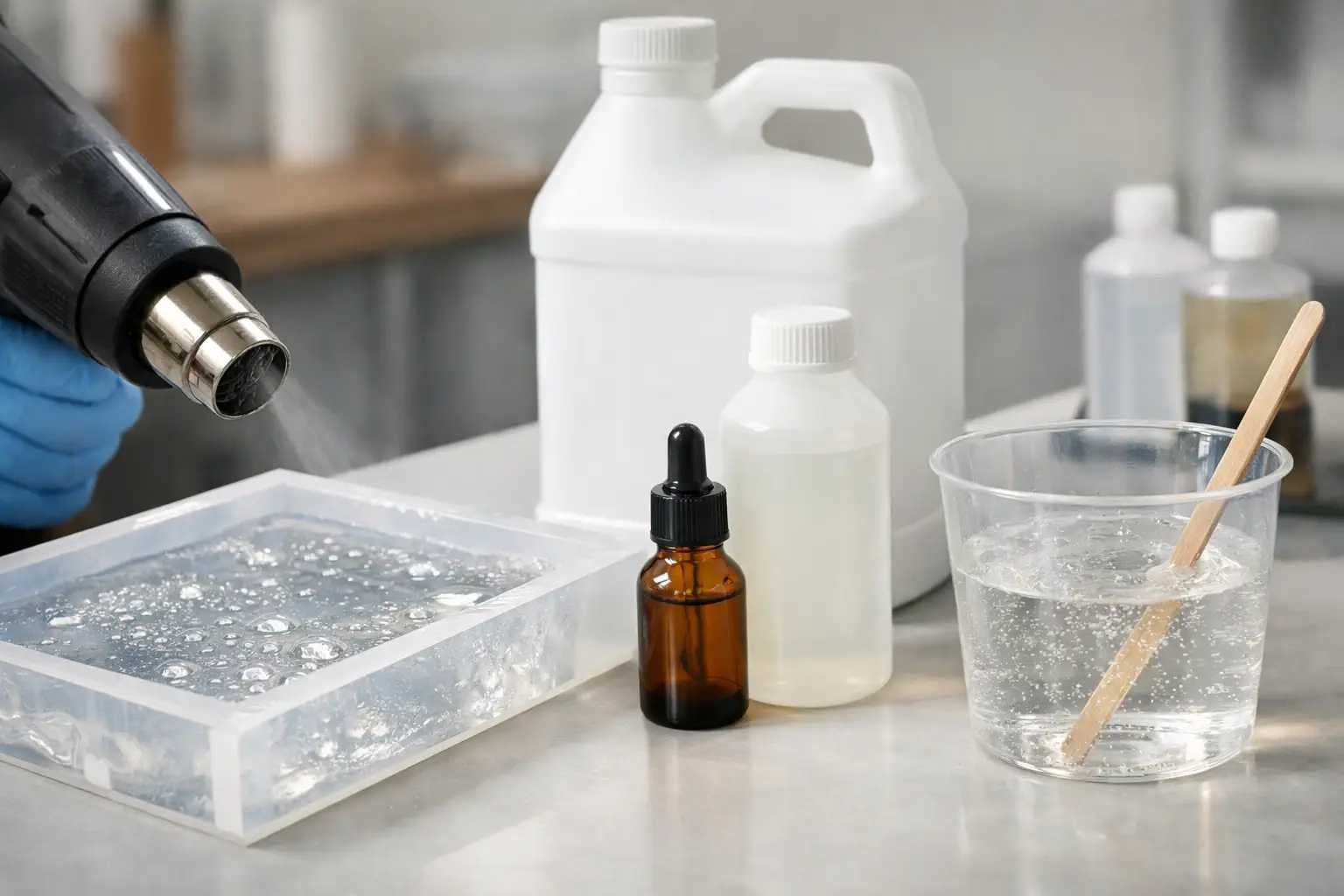
A clear epoxy coating can still fail inspection because of a few pinholes, surface craters, or trapped bubbles around an insert. Selecting the correct defoamer for epoxy resin is therefore not a minor additive decision. It affects appearance, dielectric reliability, adhesion, production yield, and the amount of rework required after cure. For industrial formulators, the right product must remove entrained air without creating secondary defects or changing the performance balance of the epoxy system.
Why Air Problems Occur in Epoxy Systems
Air can enter an epoxy formulation at several points: during resin and filler dispersion, hardener addition, pigment grinding, pumping, transfer, spraying, casting, or vacuum release. High-speed mixing is an obvious source, but it is not the only one. Air can also be carried in porous fillers, introduced through recirculation equipment, or generated when a wet substrate releases moisture during cure.
Foam and entrained air are related but different problems. Foam is usually visible at the surface during mixing or application. Entrained air consists of small bubbles dispersed through the liquid film, adhesive bead, or casting compound. A surface defoamer may collapse foam quickly yet provide limited benefit for fine bubbles trapped in a high-viscosity epoxy compound. For this reason, formulation teams should define the actual defect before choosing an additive.
Epoxy chemistry makes the issue more demanding. Viscosity rises as the system advances, especially after curing-agent addition. Once viscosity increases, small bubbles may no longer rise and break before gelation. Filled systems, thixotropic adhesives, and heavily pigmented coatings are particularly vulnerable because particles slow bubble movement and create sites where air can remain trapped.
How a Defoamer for Epoxy Resin Works
A defoamer works by destabilizing the liquid film surrounding air bubbles. It spreads at the gas-liquid interface, weakens the foam lamella, and helps smaller bubbles merge into larger bubbles that can escape. In practice, the additive must be sufficiently incompatible to act at the interface, but not so incompatible that it creates craters, fisheyes, haze, poor intercoat adhesion, or gloss variation.
This balance is why a defoamer cannot be selected only by a supplier’s general description. A product that performs well in a solventborne epoxy primer may cause surface defects in a clear, high-gloss floor coating. A defoamer suited for a mineral-filled electrical casting formulation may not be appropriate for a thin-film protective coating applied by spray.
Silicone-based defoamers are commonly effective at low dosage and can provide strong foam knockdown. Their high efficiency also requires control, particularly in coatings where surface appearance and recoating are critical. Mineral oil-based or hydrophobic particle-based products may offer good bulk defoaming in certain systems but can influence clarity, color, or long-term compatibility. Polymeric and silicone-free defoamers are often considered when surface sensitivity, paintability, or coating compatibility is the main concern. The best chemistry depends on the resin, curing agent, solvent package, pigments, fillers, and application method.
Select by System, Not by Additive Family Alone
Start with the epoxy formulation and its end-use conditions. Liquid bisphenol A epoxy resins such as CYD-127 and CYD-128 behave differently from novolac systems, modified epoxy resins, or highly filled encapsulation compounds. The curing agent also matters. An amine-cured coating, a polyamide-cured anticorrosive coating, and an MTHPA-cured electrical insulation resin have different pot life, viscosity profiles, cure temperatures, and surface requirements.
For electrical encapsulation and casting, the primary target is often internal bubble release. Voids can reduce dielectric strength, create partial-discharge risk, and weaken heat transfer around components. In these applications, a low-foam raw-material package, controlled mixing, vacuum treatment, and a compatible deaerating additive may all be required. A defoamer alone cannot compensate for inadequate vacuum capability or moisture-contaminated fillers.
For epoxy coatings, the decision usually centers on surface quality. The additive must suppress foam generated during manufacture and application while avoiding craters, poor leveling, gloss loss, or intercoat adhesion issues. Formulators should test the defoamer at the intended dry-film thickness and application method. A product that appears clean on a drawdown bar may behave differently under airless spray, roller application, or high-build plural-component equipment.
Structural adhesives and composite resins need a separate assessment. In an adhesive bond line, bubbles can reduce effective contact area and concentrate stress. In fiber-reinforced composites, air removal depends on wet-out, resin viscosity, fiber architecture, vacuum, and cure schedule. A defoamer can assist processing, but excessive use may change surface energy and affect adhesion to fibers, substrates, or a subsequent coating layer.
Dosage and Addition Stage Control Results
Most defoamers are used at low levels, commonly expressed as a percentage of the total formulation. The optimum dosage is not necessarily the highest level that gives the fastest foam collapse in the mixing tank. Overdosing can create incompatibility and surface defects that only become visible after cure.
Begin screening at the supplier’s recommended range and evaluate several points within that range. Test the additive in the complete formulation, including pigments, fillers, diluents, accelerators, and curing agent. An evaluation made in resin alone is useful for initial compatibility but cannot predict performance in a filled production formula.
Addition stage is equally important. In many epoxy coating formulations, part of the defoamer is introduced during dispersion to control process foam, with the balance added during letdown to improve final air release. For two-component systems, verify whether the defoamer should be placed in the resin side, the hardener side, or both. It must remain stable during storage and should not create separation, sedimentation, or viscosity drift.
Mixing conditions can either support or defeat the additive. High shear may disperse a defoamer effectively, but excessive shear can introduce more air than the formulation can release. After high-speed dispersion, allow a controlled deaeration period before filling or application. For castings and encapsulants, use vacuum deaeration where process design allows it, and confirm that the defoamer does not cause excessive expansion under vacuum.
A Practical Test Program for Industrial Buyers
A short but disciplined screening program prevents expensive production trials. First, compare the untreated control with candidate defoamers at several dosage levels. Record foam height after mixing, time to foam break, and the amount of visible entrained air after a defined rest period. Then apply or cast the material under realistic production conditions rather than relying on a single laboratory drawdown.
Inspect cured samples for pinholes, craters, fisheyes, haze, gloss variation, and voids. For adhesion-sensitive products, include adhesion testing after cure and after any relevant humidity, thermal cycling, or chemical exposure. Electrical formulations should be evaluated for dielectric properties and internal void content. Where the system will be recoated, assess intercoat adhesion directly.
Storage stability must also be part of the decision. A defoamer that performs well immediately after manufacture may separate or lose efficiency after extended warehouse storage, temperature cycling, or shipment. Procurement teams should request consistent technical documentation, batch traceability, packaging options, and confirmation of lead time for repeat orders. The lowest initial additive price is rarely the best commercial outcome if it increases rejects or creates supply interruptions.
Common Problems That Are Not Solved by Defoamer
When bubbles persist, check the process before increasing dosage. Water contamination in resin, hardener, solvents, fillers, or compressed air can produce defects that resemble poor defoaming. Incompatible dispersants, wetting agents, or leveling additives may stabilize foam or change the surface behavior of the defoamer. Excessive filler loading, cold material temperature, and short pot life can also prevent air from escaping before gelation.
Surface craters deserve special attention. They may indicate defoamer overdose, but they can also result from substrate contamination, silicone transfer from the production environment, poor substrate cleaning, or an imbalance between defoamer and leveling agent. Changing several additives at once makes diagnosis difficult. Adjust one variable at a time and retain a control panel for comparison.
Dahua New Materials supports epoxy manufacturers with liquid resins, curing agents, and formulation additives that can be matched to coating, adhesive, composite, and electrical applications. For high-volume operations, sourcing compatible materials through a dependable supply program also reduces the risk of unexpected formulation changes between production batches.
A well-chosen defoamer should become almost invisible in the finished product: no persistent foam in the tank, no bubbles in the cured section, and no surface defects created by the additive itself. The most reliable path is to evaluate it as part of the full epoxy system and the actual production process, then lock the selected grade, dosage, and addition procedure into the manufacturing specification.