

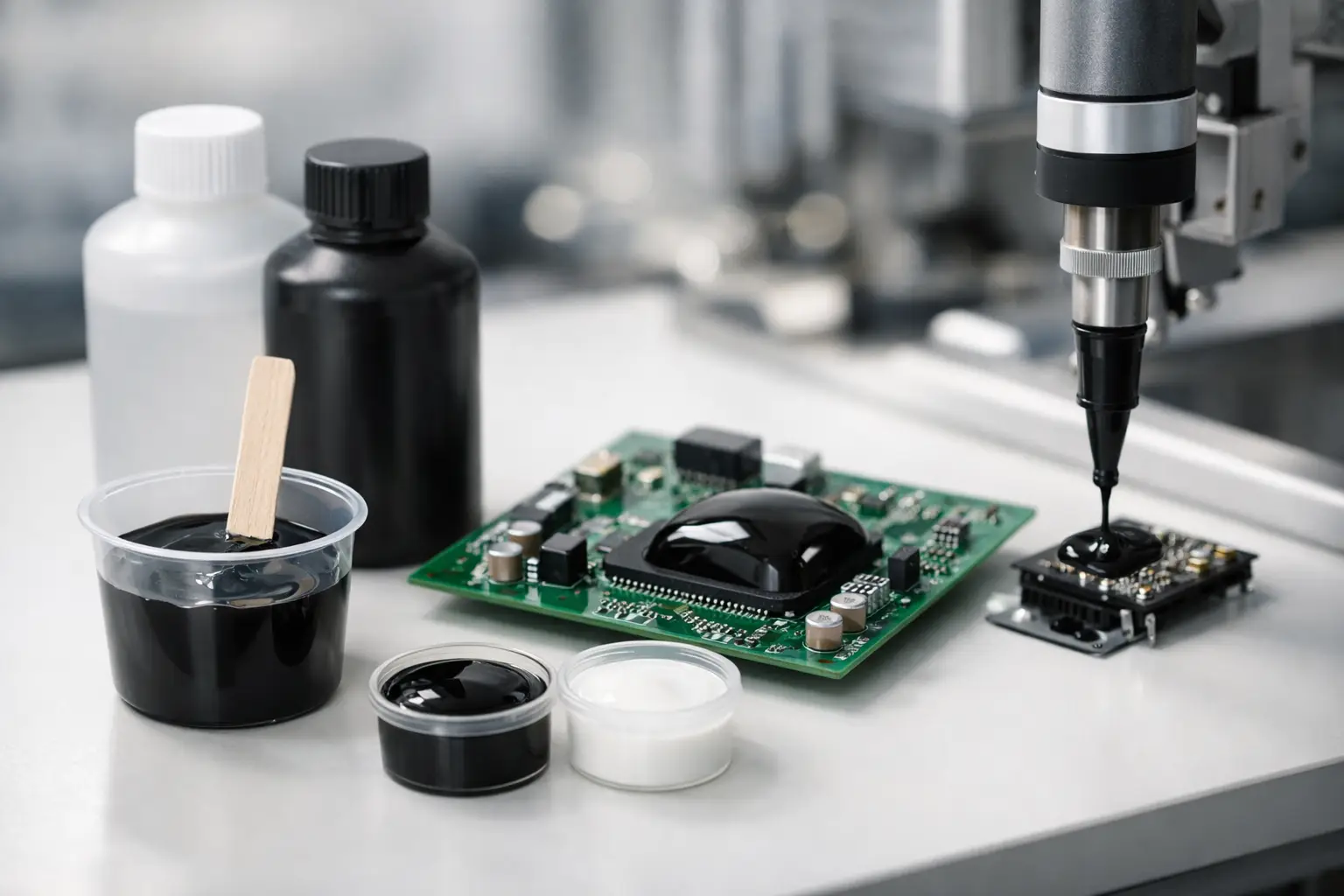
Encapsulation failures rarely begin with the resin alone. They often result from a mismatch between viscosity and fill geometry, cure schedule and part temperature limits, or filler loading and electrical performance. Selecting the best epoxy encapsulation materials means building a compatible system around the actual operating conditions of the component, not buying a single material based on a general data sheet.
For industrial electronics, electrical insulation, sensors, transformers, coils, and potted assemblies, the material package must protect against moisture, vibration, heat cycling, chemical exposure, and electrical stress while remaining practical to meter, mix, degas, and cure at production scale.
What Defines the Best Epoxy Encapsulation Materials?
A strong encapsulation formulation begins with four material groups: the epoxy resin, curing agent, fillers, and functional additives. Each contributes to final performance, but their interaction determines whether the system flows into narrow gaps, releases air, cures consistently, and survives the service environment.
The best choice depends on the application. A low-viscosity potting compound for a tightly wound electrical coil has different priorities than a high-temperature encapsulant for power electronics. Likewise, a fast room-temperature repair system is not automatically suitable for a large casting where exotherm, shrinkage stress, and internal temperature must be controlled.
Buyers should evaluate complete formulation behavior, including mixed viscosity, usable pot life, gel time, cure temperature, glass transition temperature, hardness, coefficient of thermal expansion, dielectric properties, and adhesion to the actual substrates. Resin and hardener selection is the foundation, but production conditions decide whether those laboratory values can be achieved consistently.
Start With the Right Epoxy Resin
Liquid bisphenol A epoxy resins remain a practical starting point for many general-purpose electrical and industrial encapsulation systems. Grades such as CYD-127 and CYD-128 offer reliable reactivity, mechanical strength, chemical resistance, and compatibility with a broad range of curing agents and additives. Their balance of performance and availability makes them suitable for formulators producing potting compounds, casting systems, coil impregnation materials, and adhesive-grade encapsulants.
Lower-viscosity resin is particularly useful where the compound must penetrate fine voids around terminals, windings, or densely assembled components. However, very low viscosity alone is not enough. The system also needs controlled cure speed so that air can escape and the material can wet surfaces before gelation.
For higher thermal and chemical resistance, multifunctional epoxy resins may be considered. NPSN 901-75, a phenolic novolac epoxy resin, can support higher crosslink density and improved resistance in demanding environments. The trade-off is that higher functionality can increase viscosity, brittleness, and cure stress if the hardener, filler package, and cure profile are not adjusted accordingly.
Resin Selection Questions for Formulators
Before choosing a resin grade, establish whether the priority is flow, heat resistance, flexibility, electrical insulation, chemical durability, or cost control. Large-volume casting may need lower viscosity and lower exotherm. Components exposed to repeated thermal cycling may need a formulation with lower shrinkage stress and a closer coefficient of thermal expansion to the protected assembly.
Resin selection should also account for procurement continuity. A technically suitable resin is not a dependable production input if grade consistency, batch documentation, bulk availability, or shipment timing are uncertain.
Match the Curing Agent to Cure Conditions and Service Life
The curing agent has a major effect on pot life, cure temperature, network structure, electrical behavior, and long-term durability. It should be selected based on both factory processing and field service requirements.
MTHPA, or methyltetrahydrophthalic anhydride, is widely used in electrical insulation and encapsulation applications because it supports low-viscosity formulations, long pot life, good heat resistance, and excellent electrical insulation. Anhydride-cured epoxy systems are especially suitable when manufacturers can use an elevated-temperature cure. Their extended working time helps with vacuum impregnation, large casting operations, and assemblies requiring complete penetration before gelation.
Anhydride systems normally require an accelerator and controlled cure schedule. This adds formulation discipline, but it gives manufacturers useful control over processing windows. Cure conditions must be validated carefully, since insufficient curing can reduce thermal, mechanical, and dielectric performance.
Amine curing agents are often selected when room-temperature or lower-temperature curing is required. They can provide faster development of handling strength and strong adhesion, but pot life may be shorter than with anhydride systems. Moisture sensitivity, amine blush, color requirements, and elevated-temperature performance should be assessed for the intended environment.
Polyamide curing agents can provide flexibility, adhesion, and chemical resistance in certain applications. They may be useful when a more forgiving, less brittle cured material is needed, although they are not a direct replacement for high-temperature anhydride-cured electrical systems.
Fillers Control Heat, Stress, Cost, and Flow
Fillers are often the difference between a basic epoxy casting resin and a production-grade encapsulation compound. Silica and mineral fillers can reduce shrinkage, lower the coefficient of thermal expansion, improve dimensional stability, and reduce formulation cost. Properly selected fillers also help manage exotherm in thicker castings.
Thermally conductive fillers are needed when the encapsulant must move heat away from power devices, LED modules, battery components, or electronic control units. Higher filler loading may improve thermal conductivity, but it generally raises viscosity and can make dispensing more difficult. It may also affect dielectric strength, depending on filler type, particle shape, moisture level, and dispersion quality.
Electrical insulation applications require close attention to filler purity and moisture. Contamination or poor drying can increase ionic content, create voids during cure, and weaken dielectric performance. For high-voltage parts, the filler package should be evaluated through dielectric breakdown, partial discharge resistance, and thermal aging tests rather than relying on generic material descriptions.
Fumed silica is commonly used as a rheology modifier when sag resistance or controlled thixotropy is required. It can help keep filler particles suspended and prevent flow from vertical or open assemblies. Excessive use, however, can trap air, increase mixing energy, and limit wetting in narrow spaces.
Additives Solve Production Problems When Used Carefully
A small amount of the right additive can improve manufacturing yield. Defoamers support air release during mixing and casting. Wetting and dispersing agents help filler incorporation. Leveling agents can improve surface quality, while accelerators allow anhydride-cured systems to reach practical cure times.
Additives should be treated as formulation tools, not universal corrections. A defoamer that works in an unfilled resin may behave differently after a high loading of mineral filler. An accelerator can shorten a slow cure but may also reduce pot life and increase exotherm. Changes should be confirmed through pilot batches and production-relevant test conditions.
For applications where appearance, optical clarity, or low ionic contamination matters, every additive should be reviewed for compatibility and extractables. This is particularly relevant for sensors, optical electronics, and high-reliability electrical assemblies.
Evaluate Processing Before Approving the Material
A formulation can meet cured-property targets and still cause costly production losses. The mixed system should be evaluated under actual dispensing, vacuum, and cure conditions. Measure viscosity at the expected shop temperature, not only at a standard laboratory temperature. Confirm pot life in the real mixing vessel and at the planned batch size.
For larger pours, track internal exotherm. Epoxy cure is exothermic, and thick sections can reach substantially higher temperatures than thin test plaques. Excess temperature may damage sensitive components, create cracking, increase shrinkage stress, or cause uneven cure through the casting.
Adhesion testing should use the actual substrates, including metal, plastic housings, ceramics, wire insulation, and coatings. Surface cleanliness and pretreatment can influence results as much as the encapsulant chemistry. Thermal cycling, humidity exposure, and electrical testing should follow the conditions that the finished product will face.
Source the System, Not Just Individual Chemicals
Procurement teams benefit when resin, hardener, accelerator, and additives can be technically matched and supplied through a coordinated source. This reduces the risk of formulation drift caused by unreviewed substitutions and makes inventory planning more predictable.
Dahua New Materials supports industrial formulators with direct manufacturer supply of MTHPA epoxy hardener, liquid epoxy resins, curing agents, accelerators, and formulation additives. For repeat production, buyers should define approved grades, required documentation, packaging format, storage conditions, lead time, and incoming quality checks before scaling orders.
The right encapsulation system is the one that protects the component and keeps the line moving. Start with the required electrical and thermal performance, then validate resin, curing agent, filler, and additive choices together at production scale.