

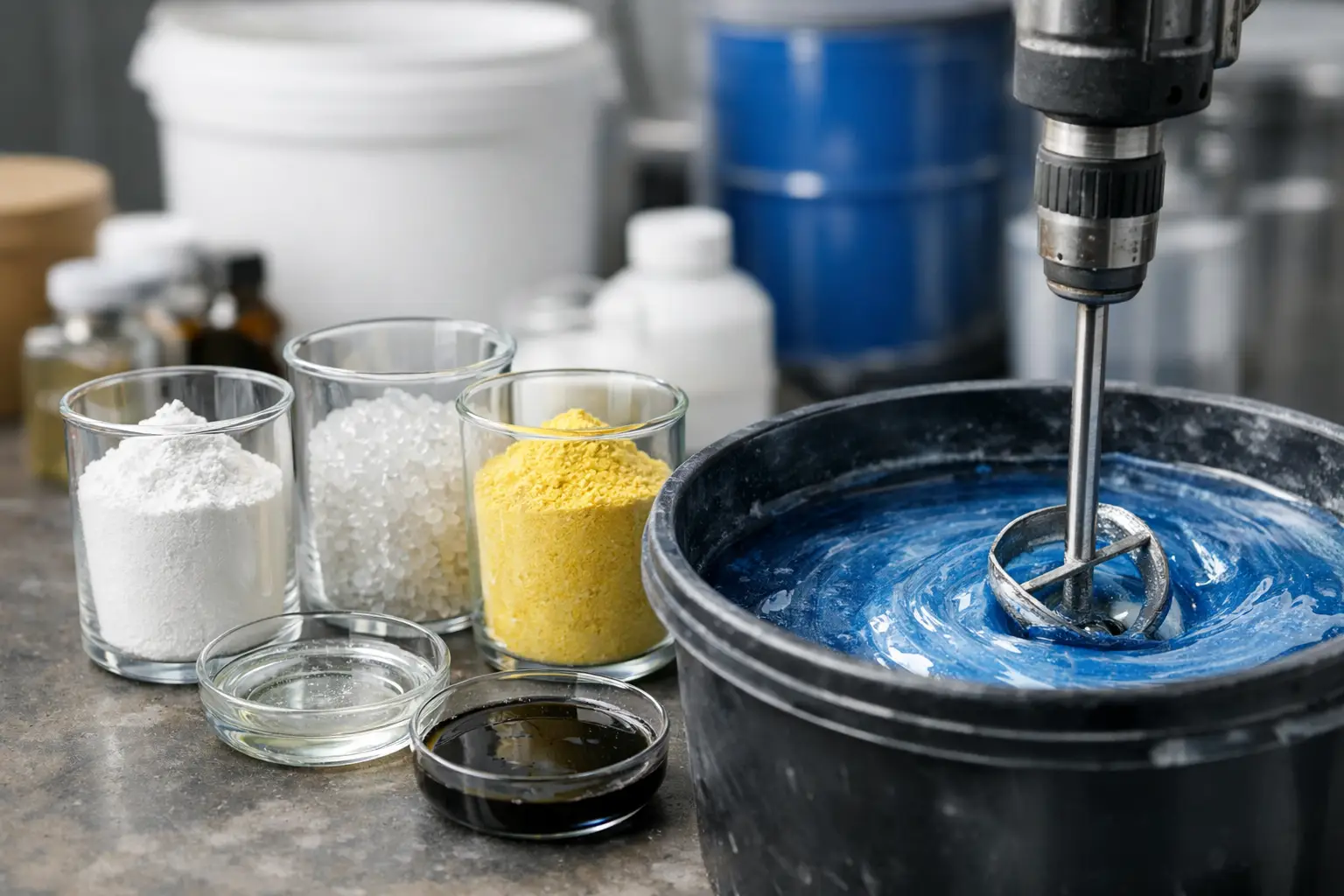
A coating can have the right epoxy resin and curing agent on paper yet still fail on the production line because of bubbles, poor wetting, pigment settling, sagging, or an uneven surface. The best additives for epoxy are therefore not selected by popularity. They are selected for the specific defect, application method, cure schedule, and performance target of the finished system.
For industrial formulators, an additive package must improve processing without weakening adhesion, chemical resistance, electrical properties, or long-term durability. A low-dose material that eliminates rework can be commercially valuable. An incompatible additive that causes craters, intercoat adhesion loss, or cure disruption can be far more costly than its purchase price suggests.
Choosing the Best Additives for Epoxy
Additives should be evaluated as part of the entire epoxy system: resin, hardener, fillers, pigments, solvents or reactive diluents, and application conditions. For example, a defoamer that performs well in a solvent-borne protective coating may behave differently in a high-build, solvent-free floor coating cured with an amine or anhydride hardener.
Start with the primary requirement. Is the production team trying to improve dispersion speed, control viscosity, prevent air entrapment, improve substrate wetting, or create a more level finish? One additive should have one clear job. Using several products to solve the same problem often creates unnecessary compatibility risk.
Formulators should also consider the curing agent. Amine-cured epoxies can be sensitive to surface effects, moisture conditions, and pot-life changes. Anhydride-cured systems, including MTHPA-based electrical and casting formulations, commonly require tight control of air release, filler wetting, viscosity, and electrical cleanliness. The additive choice needs to support those system-level requirements.
Defoamers and Air-Release Agents
Defoamers are among the most practical epoxy additives because entrapped air is a frequent cause of rejected parts and poor coating appearance. In coatings, foam can produce pinholes, craters, and reduced film continuity. In electrical encapsulation and casting, microbubbles can compromise dielectric reliability, thermal transfer, and visual inspection standards.
A defoamer breaks surface foam, while an air-release additive helps fine bubbles rise and escape from the bulk liquid. Many epoxy formulations benefit from both effects, particularly high-viscosity systems containing mineral fillers, pigments, or reinforcing materials.
The trade-off is surface quality. An overly aggressive silicone-based defoamer may eliminate bubbles but introduce cratering, fisheyes, or reduced intercoat adhesion when overdosed. Start at the supplier’s recommended low addition level, then test under actual mixing, pumping, and application conditions. Bench mixing alone rarely predicts air release during production-scale dispersion.
For filled epoxy castings, vacuum processing and controlled mixing speed remain essential. A defoamer is not a substitute for proper degassing equipment, but it can reduce cycle time and improve consistency when used correctly.
Wetting and Dispersing Agents
Dispersants help pigments and fillers distribute more uniformly through the epoxy binder. They are particularly useful in pigmented coatings, highly filled adhesives, conductive or thermally conductive compounds, and composite systems using silica, alumina, calcium carbonate, talc, carbon black, or other functional fillers.
Without adequate dispersion, particles can agglomerate. The result may be unstable viscosity, poor color development, reduced gloss, sedimentation, lower mechanical strength, or incomplete electrical performance. A suitable dispersant adsorbs onto particle surfaces and helps keep them separated during processing and storage.
The correct chemistry depends on the filler surface and resin environment. Hydrophilic mineral fillers, carbon materials, and organic pigments do not respond identically to the same dispersant. A product that improves initial grind quality may still cause viscosity drift after storage, so retain samples for stability testing rather than judging only the day-one result.
For production buyers, consistent filler quality matters as much as the dispersant itself. Changes in particle size distribution, moisture content, or surface treatment can shift the dosage requirement. Qualifying the additive and filler package together is more reliable than sourcing each component independently without formulation review.
Rheology Modifiers and Fumed Silica
Rheology modifiers control how epoxy flows at rest and under shear. They are used to prevent sag on vertical surfaces, reduce pigment settling, hold fillers in suspension, improve gap filling, and create a non-sag adhesive or sealant profile. Fumed silica is a widely used option for solvent-free and filled epoxy systems because it can produce thixotropy at relatively low addition levels.
A thixotropic epoxy becomes less viscous under mixing, pumping, or application shear, then rebuilds viscosity after application. This is useful for vertical protective coatings, structural adhesives, and gap-filling compounds. It allows the material to move through equipment while resisting slump on the substrate.
The main trade-off is processability. Excess fumed silica can sharply increase viscosity, trap air, reduce flow into narrow geometries, and complicate metering. In electrical potting compounds, too much structure can prevent complete wetting around components or reduce self-leveling. In contrast, too little rheology control may allow heavy fillers to settle during storage or transport.
Proper incorporation is critical. Fumed silica must be dispersed with sufficient shear and under controlled conditions to avoid dry agglomerates. Formulators should test viscosity at multiple shear rates, not only a single rotational-viscosity value, because application performance is determined by the full flow profile.
Leveling Agents and Surface-Flow Additives
Leveling agents help an epoxy coating form a smooth, uniform film after application. They can reduce brush marks, roller texture, orange peel, and minor surface irregularities. In industrial coatings, better leveling can improve appearance while supporting more consistent film coverage.
This benefit must be balanced against coating architecture. A very mobile surface additive may improve flow but can contribute to slip, reduced intercoat adhesion, or surface contamination if selection and dosage are not controlled. The risk is higher in multilayer systems where a primer, intermediate coat, and topcoat must bond reliably.
Leveling agents should be screened with the actual application method. Spray, roll, curtain coating, and manual application impose different shear and drying conditions. Film thickness also matters. A product that levels well in a thin solvent-borne film may not give the same result in a thick, solvent-free epoxy coating.
Reactive Diluents and Viscosity-Reduction Options
Although reactive diluents are often treated as resin modifiers rather than conventional additives, they are frequently used to lower epoxy viscosity without adding volatile solvent. This can improve filler loading, wetting, mixing efficiency, substrate penetration, and application behavior.
The advantage is clear in high-solids and solvent-free formulations. Lower viscosity can reduce energy use during mixing and make processing easier at lower temperatures. However, reactive diluents can change crosslink density, flexibility, heat resistance, chemical resistance, and electrical properties. Their effect depends on functionality, molecular structure, dosage, and cure chemistry.
For structural adhesives or high-temperature electrical insulation, the lowest possible viscosity is not always the right goal. A formulation may need to retain a certain network density and thermal performance. Evaluate reactive diluents through full cured-property testing, including glass transition temperature, tensile or flexural properties, chemical resistance, and dielectric performance where relevant.
Adhesion Promoters and Coupling Agents
Adhesion promoters are used when the epoxy must bond reliably to challenging substrates such as metal, glass, mineral fillers, ceramics, or certain plastics. Silane coupling agents are common in mineral-filled systems and can improve the interface between inorganic surfaces and the organic epoxy network.
Their value is often seen after environmental exposure rather than immediately after cure. A bond may pass initial pull testing but lose strength after humidity, thermal cycling, or chemical contact. The right coupling agent can improve wet strength and reduce interface failure, especially in coatings, composites, and electrical insulation compounds.
Surface preparation remains necessary. No adhesion additive can compensate for oil, oxidation, moisture, dust, or poor surface profile. Treat adhesion promoters as part of a controlled substrate-preparation and formulation process, not as a corrective shortcut.
A Practical Qualification Method
A disciplined screening plan prevents unnecessary plant trials. First, establish a control formulation with documented viscosity, pot life, cure profile, appearance, and cured properties. Then add one candidate material at a time, beginning at a conservative dosage. Compare the results after mixing, after storage, during application, and after full cure.
For most industrial epoxy programs, qualification should include compatibility, viscosity behavior, pot life, air release, surface appearance, adhesion, mechanical properties, and the application-specific requirement such as electrical insulation, chemical resistance, or thermal cycling. For filled formulations, review sedimentation and redispersibility after storage. For coatings, include intercoat adhesion and defect inspection after the intended cure schedule.
Supply continuity should also be part of the decision. A technically acceptable additive is not enough if the grade varies between shipments or lead times create production risk. Dahua New Materials supports epoxy manufacturers with stocked formulation additives alongside liquid epoxy resins, curing agents, accelerators, and high-volume MTHPA hardener supply, helping buyers match material selection with practical procurement requirements.
The strongest additive package is usually the simplest one that delivers repeatable processing and finished-part performance. Choose it from measured formulation data, confirm it under real production conditions, and secure a supply plan that keeps the same results coming from batch to batch.